Jeremy Meeks and the media reinvention of a public identity
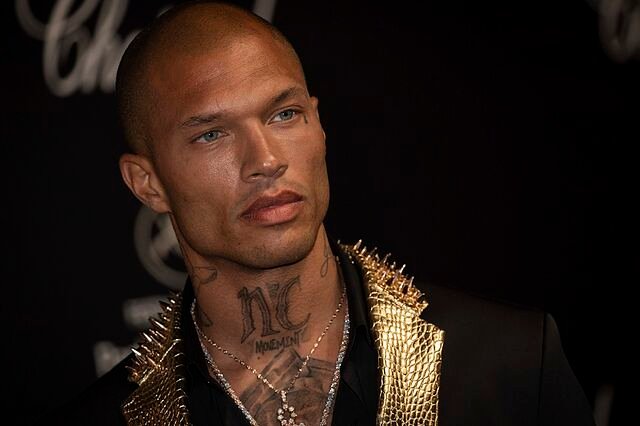
El modelo estadounidense Jeremy Meeks durante su participación en un desfile de moda internacional.
Jeremy Meeks represents an unusual case of transformation within contemporary cultural systems. His trajectory illustrates how virality, aesthetics, and personal narrative can convert symbolic capital into economic value, shifting a profile shaped by legal conflict into one integrated within the global fashion industry.
Origin and social constraints
Born in 1984 in Tacoma, Washington, Meeks grew up in a fragmented family environment with early exposure to criminal dynamics. During adolescence and early adulthood, his involvement in gang-related structures influenced his personal and professional development. This stage reflects structural limitations in access to traditional pathways of social mobility.
Virality as a turning point
In 2014, his arrest in California led to the publication of his mugshot, which rapidly became a global viral phenomenon. The reaction was not driven by the legal context but by the aesthetic perception of his image. This episode highlights a key dynamic of digital culture: appearance functioning as a transactional asset within attention economies.
Entry into the fashion industry
After serving a prison sentence of approximately two years, Meeks was approached by modeling agencies that identified his commercial potential. His runway debut took place at New York Fashion Week, marking his entry into a highly competitive system. This transition was not based on prior technical training but on a specific market demand for unconventional profiles.
Professional diversification and media expansion
Following his consolidation as a model, Meeks expanded into acting and the development of fashion-related projects. This diversification reflects a strategy of leveraging visibility, where public identity becomes a business platform. His participation in international campaigns reinforced his global positioning.
Personal relationships and public exposure
His relationship with Chloe Green, linked to the Topshop group, amplified his media exposure and integrated him into high-visibility celebrity circuits. Such relationships function as accelerators within the attention economy, where personal narrative becomes part of brand construction.
Controversy and reinterpretation
Meeks’ criminal past remains part of his public narrative but is reframed as a transformation story. Both industry and audience reinterpret this background as a trajectory of reinvention, where the tension between past and present becomes a functional narrative element supporting his positioning.
Cultural impact and structural reading
His case reflects a shift in mechanisms of legitimacy within contemporary culture. Virality increasingly replaces traditional gatekeeping structures, while image acquires autonomous value. Meeks’ trajectory illustrates how digital platforms can redefine individual paths and reshape hierarchies within creative industries.
Current positioning and outlook
Currently, Meeks maintains activity across modeling, acting, and editorial ventures. His figure operates as a reference point in discussions on personal branding and attention economics. His career does not follow a linear progression but evolves through continuous adaptation to shifting media environments.