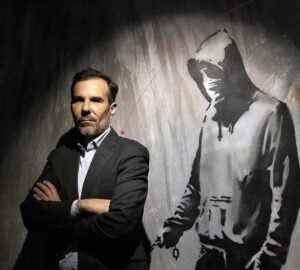
Banksy and art as global intervention
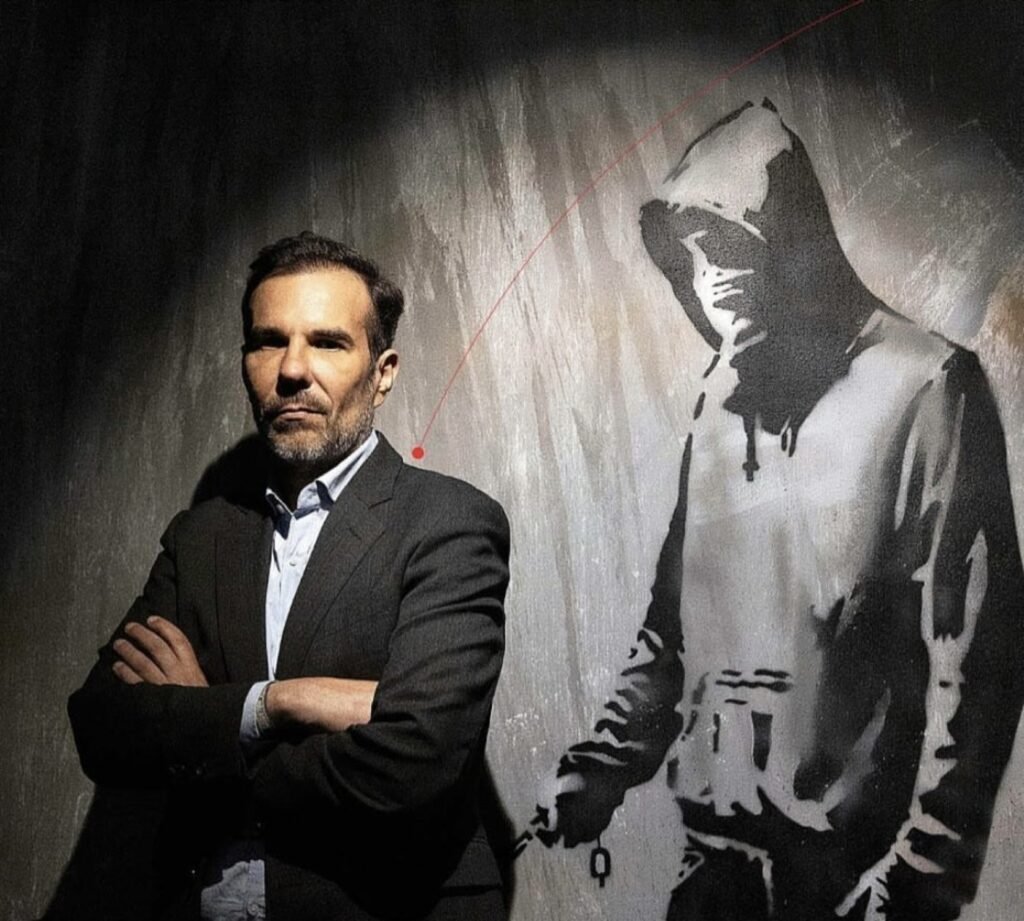
Intervención callejera de Banksy que utiliza el esténcil para expresar tensiones sociales y cuestionamientos al poder.
Banksy develops an artistic practice that combines urban intervention, anonymity, and social critique. Emerging in Bristol during the 1990s, he built a visual language based on stencil techniques that enable rapid execution and high legibility. His work operates as a visual commentary on power, consumption, and conflict, integrating street space, the art market, and media into a unified strategy of symbolic circulation.
Origins and environment in Bristol
Banksy formed within Bristol’s underground scene, where graffiti, electronic music, and alternative culture converged. This context enabled a visual language rooted in direct intervention in public space. The adoption of stenciling responds to an operational need: reducing execution time while increasing precision. This technique allows replication and the consolidation of a recognizable identity across multiple cities.
Visual language and symbolic logic
Banksy’s works present simple compositions with strong conceptual weight. He uses figures such as children, police, or animals to construct contrasts that expose social tensions. The image functions as a device of synthesis, where familiar elements acquire new meanings through recontextualization. This visual economy facilitates mass dissemination and allows messages to be understood without complex mediation.
Global expansion and market validation
From the 2000s onward, Banksy moved beyond street circuits and entered the international art market. Auctions in major institutions consolidated the economic value of his pieces, contributing to the broader valuation of street art. While maintaining a disruptive logic, he established a centralized authentication system that regulates circulation and limits forgery.
Intervention strategies and performance
Banksy’s practice extends beyond murals. He has inserted works into museums without authorization, developed ephemeral installations, and used public events as artistic platforms. These interventions challenge the institutional framework of art and expand the concept of the artwork itself. The action becomes part of the meaning, shifting attention from object to process.
Controversies and structural tensions
The illegal nature of graffiti generates conflicts with authorities and property owners. Some works are removed while others are preserved, opening debates about ownership and cultural value. At the same time, his presence in the art market creates tension between critique of the system and participation within it. These contradictions reinforce rather than weaken his narrative.
Anonymity as identity architecture
Banksy’s identity remains unconfirmed, although often linked to Robin Gunningham. This anonymity serves a strategic function: avoiding legal consequences, increasing public interest, and shifting focus toward the work itself. The absence of a visible author strengthens symbolic circulation and allows the message to operate independently of personal identity.
Recent production and thematic continuity
In recent years, Banksy has remained active through interventions in contexts of conflict and social tension. His works continue to address themes such as war, surveillance, and inequality. The selection of locations reinforces the message, linking territory with meaning. This approach maintains conceptual coherence while adapting to contemporary scenarios.
Impact and projection in contemporary art
Banksy redefines the relationship between art, public space, and communication. His model integrates visual production, media strategy, and market control. The ability to generate instantly readable images amplifies global reach. His influence extends into design, activism, and digital culture, consolidating a framework in which art functions as a tool of social intervention.