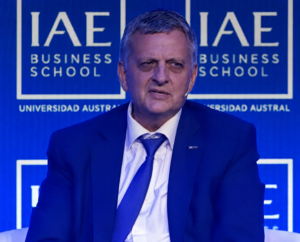
Miguel Galuccio, the engineer from Paraná who ended up leading Vista Energy
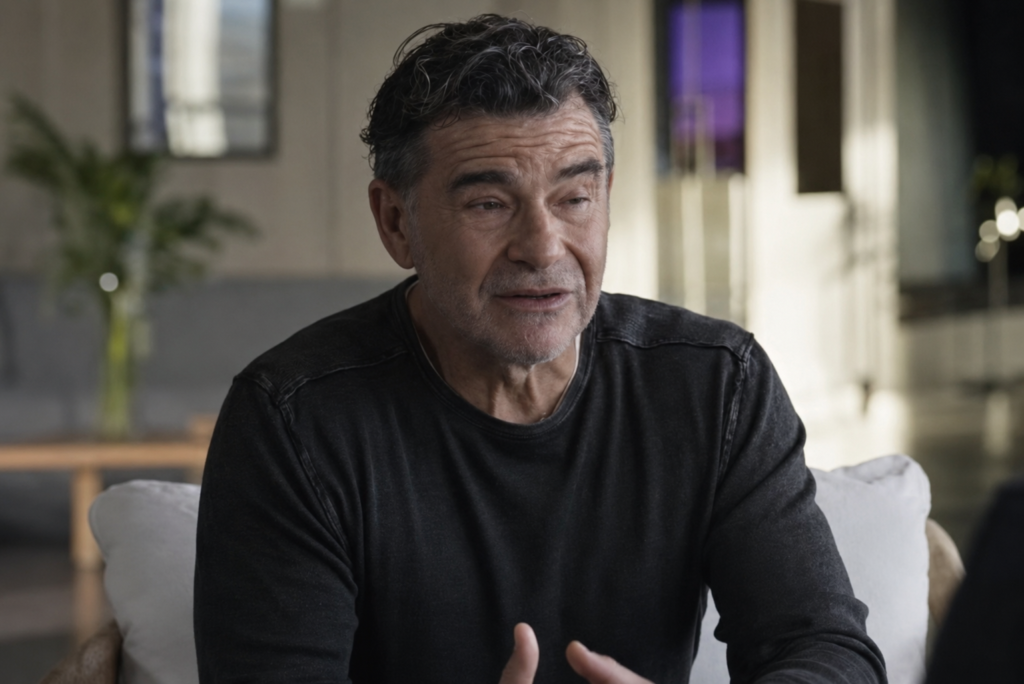
El estilo de Galuccio: diseñar la cultura antes que el capital.
Born in Entre Ríos in 1968, he climbed almost every step of the energy sector before founding the country’s largest independent oil company.
Long before people began calling him “the father of Vaca Muerta,” Miguel Galuccio raised chickens to sell eggs and made popcorn for the bar on the corner. He was a boy from Paraná, the son of a baker who later opened a supermarket and an English teacher, the eldest of four brothers. From that background emerged the petroleum engineer who today chairs Vista Energy, the company listed on the New York Stock Exchange that reached a value of 8 billion dollars.
His career began with an overnight bus. After finishing high school at the Industrial School of Paraná, he got on a coach that dropped him off in Retiro at five in the morning, carrying a bag and the address of a university residence in Belgrano. He studied petroleum engineering at the Instituto Tecnológico de Buenos Aires (ITBA) and graduated in 1994. To support his studies, when the family finances were not enough, he requested an honor loan from the institute itself: he was not a brilliant student, but it was granted to him. He finished paying off that debt many years later. Today he sits on the ITBA board of beneficiaries, on the other side of the counter.
From a southern oilfield to the world
His vocation did not arrive as a sudden revelation. Galuccio says that as a child he was drawn to nature and animals, and that only during field practice at a Patagonian oilfield did he feel that this was his place: open air, technology, teams and diverse people. He joined YPF shortly after graduating and was sent to operate fields in the south. When the company bought the American firm Maxus in 1995, he joined that company; in 1998 he was transferred to Indonesia. After YPF passed into the hands of Repsol in 1999, he moved to the oilfield services company Schlumberger, where he went on to manage operations for Mexico and Central America and to chair one of its most important divisions, based in London.
That international stage was, in his own words, what shaped him as an executive. He arrived in the United States with English so basic that he could barely order a hamburger by phone, and ended up leading teams on a global scale. His family moved with him. He had met his wife, Verónica, when he was very young at the club, while playing hockey; their children, Matías and Malena, grew up between Jakarta, the United States and England. An episode at a school in Indonesia, where Matías raised his hand when they asked who the Indonesian children were, pushed them to buy a farm in Entre Ríos and return every year so the children would know where they came from.
The return that marked him
In 2012, the phone call he did not want to take came. The government wanted him to lead YPF, recently renationalized, and Galuccio left London to become the company’s first president and CEO after the expropriation. He found a country with an energy trade balance in deficit, imports of liquefied gas cargoes and scheduled supply cuts in winter. His bet was to build a professional team, repatriate talent and start investing in a formation that at the time was almost a promise: Vaca Muerta. The agreement with Chevron to develop Loma Campana was the first major risk investment in that area. He led the state-controlled oil company until 2016.
A year later, together with several partners, he founded Vista —initially Vista Oil & Gas—, the first independent public oil company focused on Vaca Muerta. In 2021, he renamed it simply Vista, under the motto Energy for tomorrow. Today it is the second-largest operator in the Neuquén Basin and produces, according to Galuccio himself, between 135,000 and 140,000 barrels per day.
The nickname Vaca Muerta left him
The nickname “father of Vaca Muerta” was earned over time, as what once seemed like an expectation began to support a large part of the country’s external accounts. “There was no magic, there was a lot of effort,” he summarized in an interview when asked what the journey had been like. The Neuquén Basin today represents around 70% of Argentina’s oil production and left the country with an export surplus. At Vista’s offices, they keep the first barrel of unconventional oil they produced as a relic: a white drum that presides over company dinners.
Galuccio remains active in the sector’s agenda. He participated as a speaker at Argentina Week in New York, the event through which the Government seeks to attract investors, a showcase he knows well because his company has been listed there since its first day.