Fei-Fei Li, the godmother of artificial intelligence
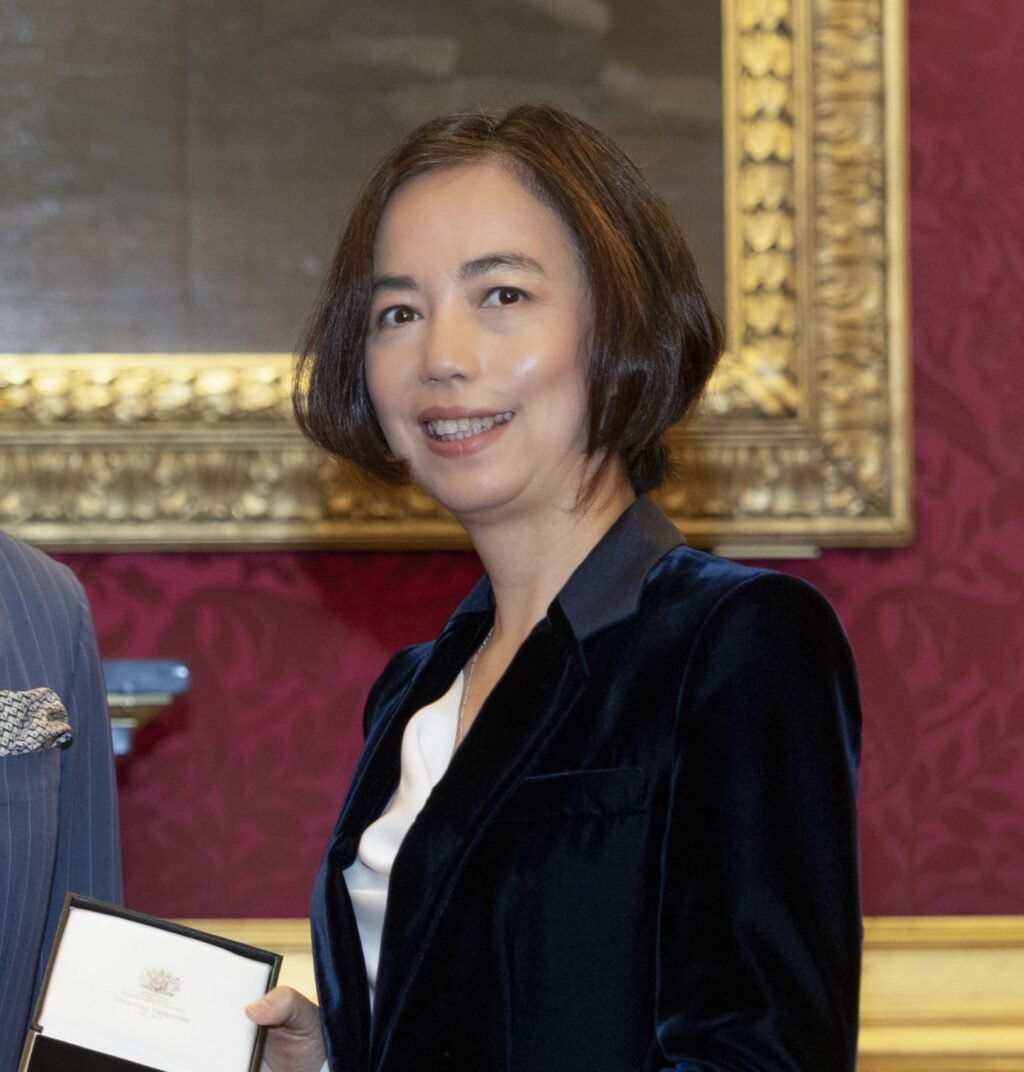
Fei-Fei Li recibió el Queen Elizabeth Prize for Engineering de manos del rey Carlos III, en noviembre de 2025.
In 2007, a colleague warned Fei-Fei Li that she had taken her idea too far. She wanted to build an image database so large that almost everyone considered it absurd: the entire field believed that the problem in computer vision lay in the algorithms, not in the data. Five years later, a model trained on that database shattered every previous result and triggered the deep learning boom. Today, Li leads a startup valued at more than one billion dollars, advises governments and carries a nickname that makes her uncomfortable.
From Chengdu to a dry-cleaning shop in New Jersey
She was born in Beijing in 1976 and raised in Chengdu. At the age of fifteen, she emigrated with her parents to Parsippany, a suburb of New Jersey, with little English and even less money. Her parents found cashier jobs, while she worked in Chinese restaurants.
When she entered Princeton, her mother’s health deteriorated and the family needed a more stable source of income. They opened a dry-cleaning shop. Li was the only one who spoke English, so she handled everything: answering the phone, dealing with customers, passing inspections and managing the billing. She joked that she was the CEO of the shop while solving physics problems on campus.
The work did not end when she left for Caltech to pursue her doctorate. She continued managing the dry-cleaning business remotely until halfway through graduate school. She came away from that period with a conclusion she still repeats today: science is not a linear path, and no one has all the answers from the beginning.
The bold question
At Princeton, she chose Physics because it allowed her to ask the biggest possible questions about the universe. Over time, her own bold question moved into another field: what intelligence is, how it emerges and whether a machine could learn it.
She earned her doctorate from Caltech in 2005 under the supervision of Pietro Perona and Christof Koch. She was an assistant professor at the University of Illinois Urbana-Champaign and Princeton before joining Stanford in 2009. She received tenure in 2012 and became a full professor in 2017.
Meanwhile, the field of computer vision had reached an impasse. The algorithms were not working, and no one fully understood why. Li searched for answers outside computer science —in psychology, linguistics and the way human beings organize the world— and noticed something that had been hiding in plain sight: people learn from an enormous amount of experience, while computers were being given datasets containing only a few hundred images.
ImageNet, or how stubbornness changed an entire field
The result was ImageNet: 15 million labeled images divided into 22,000 categories and organized according to principles drawn from human cognition. In 2010, she turned it into an annual competition that required researchers to test their algorithms against the same dataset.
The turning point came in 2012. A neural network called AlexNet, trained on ImageNet, crushed every previous result. That was when the field understood that deep learning truly worked. Everything that followed —object recognition, autonomous systems, medical image analysis and much of the industry— emerged from that turning point.
Li insists on describing the project in modest terms: they wanted to build a common language and a reliable measuring stick for the research community. From that came the nickname “the godmother of artificial intelligence.”
The nickname she never asked for
The label makes her uncomfortable, and she has said so publicly. Her reasoning, explained at Fortune’s Most Powerful Women Summit in 2024, is that the history of science and technology is filled with men described as founding fathers or godfathers, and that when women immediately reject such titles, they end up surrendering their voice. She accepted it for that reason, which was more political than personal.
At the same time, she built a line of work that does not appear in academic papers. In 2015, she created a Stanford summer camp with her former student Olga Russakovsky for high school girls interested in AI. In 2017, that program became AI4ALL, an organization dedicated to diversifying the group of people who build these systems. That same year, she co-founded the institute that now defines her almost as much as ImageNet does.
Stanford HAI and the politics of artificial intelligence
In 2019, she founded the Institute for Human-Centered AI with former Stanford president John Etchemendy. Its premise is that technology does not exist in a vacuum and that building trustworthy systems requires engineers, social scientists, ethics specialists and communities sitting at the same table.
From there, she moved into the public arena. She testified before the United States Congress, advised President Biden, joined the scientific advisory board of the United Nations secretary-general in 2023 and published her memoir, The Worlds I See.
Where she disagrees with the godfathers
This is the disagreement that defines her position in relation to her peers. Geoffrey Hinton, Yoshua Bengio and other leading figures in the field have warned about the existential risk posed by AI: the possibility that these systems could eventually threaten humanity. Li does not share that hierarchy of concerns. She respects the debate, but her attention is focused on harms that are already occurring: bias, job displacement, disinformation and the concentration of power.
In 2024, that position placed her at the center of a specific dispute. She published a column in Fortune opposing California bill SB 1047, which sought to regulate frontier models. Her argument was that the law would punish developers, stifle open-source development and disproportionately harm the weakest participants in the ecosystem —the public sector, academia and small companies— without solving the problems it claimed to address.
The response was harsh. Bengio replied in the same publication, arguing that the bill represented a minimum baseline rather than a burden. Gary Marcus wrote her an open letter pointing out that the law did not require developers to anticipate every possible use, but rather to address specific critical harms. Several critics also raised an uncomfortable point: World Labs, her startup, had received funding from Andreessen Horowitz, one of the venture capital firms lobbying against the bill. Governor Newsom ultimately vetoed the legislation.
Li never moved away from her position: she supports governing AI, but opposes doing so through instruments she considers poorly calibrated.
Spatial intelligence
Her current bet is that language is not enough. World Labs, the company she co-founded and leads, works on what she calls spatial intelligence: a system’s ability to understand and interact visually with the physical world, as humans do. The company surpassed a valuation of one billion dollars in just four months and, in November 2025, launched Marble, a tool capable of generating downloadable three-dimensional worlds from written descriptions.
The award from Charles III
On November 5, 2025, at St James’s Palace, King Charles III presented her with the Queen Elizabeth Prize for Engineering. She shared it with Yoshua Bengio, Bill Dally, Geoffrey Hinton, John Hopfield, Jensen Huang and Yann LeCun: the same Hinton and Bengio with whom she publicly disagrees over AI risks.
The prize, which in previous editions recognized the architects of the internet, the creators of GPS and the developers of modern wind energy, honored the engineering foundations of modern machine learning.