Hernán Cattáneo
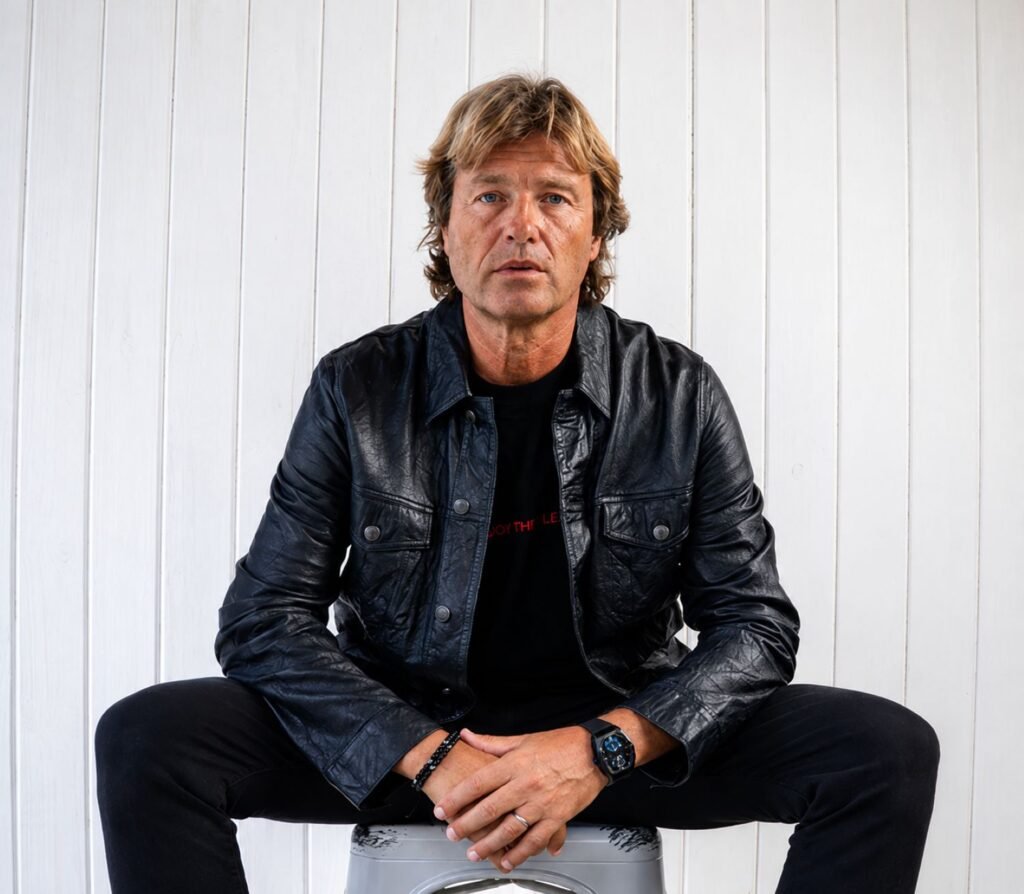
Hernán Cattáneo llevó el progressive house argentino a escenarios de todo el mundo y fue el primer DJ en presentarse en el Teatro Colón.
He started playing records at a time when, in Argentina, being a DJ was considered little more than a minor occupation. Four decades later, he has accumulated more than 4,000 shows in 300 cities, became the first DJ to perform at the Teatro Colón, and had a documentary released on Netflix. Along the way, he had to confront resistance from the classical music establishment, carry the prejudice linking electronic music with drugs, and respond when tragedy came close. This is the full journey.
Some records brought back from New York
The scene that opens this story has neither smoke nor lights. It is a kid from Caballito, raised on the European synth-pop of the 1980s —Depeche Mode, New Order, Simply Red, Level 42— who, in 1987, was shown a few 12-inch records a friend had bought at a New York record store. It was Chicago house.
That sound, and Frankie Knuckles above all, rearranged his musical universe. Derrick May and Inner City came next.
Cattáneo started very young, playing private parties and Buenos Aires clubs at a time when an Argentine DJ was not regarded as an artist but as an employee of the venue. The distance between those beginnings and everything that followed can be measured in decades of largely invisible work.
Clubland, and then the world
His residency at Clubland, the Buenos Aires nightclub that the international press once ranked among the best clubs in the world, became his platform. There he completed the definition of what would become his signature: melodic, deep progressive music delivered through very long sets structured like journeys with different stops along the way.
The decisive push came from abroad. In 1997, Paul Oakenfold invited him to join his European tour, and that door never closed again. He became Cream’s first South American resident, with residencies in Liverpool and Ibiza, and later added Pacha in both Buenos Aires and Ibiza.
In 2001, tired of flying 14 hours each way, he moved to London.
That same year, he entered British magazine DJ Mag’s Top 100 for the first time, straight in at number 50, something he described as incredible. Then came the climb: 19, 22 and, in 2004, number 6. It was an unusual position for someone working within a relatively niche branch of electronic music in a ranking usually dominated by more mainstream acts. He remained on the list for 11 consecutive years, through 2011.
The decade of compilations
His name became firmly established through the mix CDs he recorded for British label Renaissance. He began with the first volume of The Masters Series in 2004, followed it with a second installment, the Sequential series, and the album chosen by the label as its 50th release in 2009.
In 2010, he released Parallel, a double album that separated day from night: one slower mix, close to downtempo, and another unmistakably progressive. Later came his work for Australian label Balance.
He has performed in places that have little in common with a nightclub: Coachella, Burning Man, the Hollywood Bowl, Liverpool Cathedral, and a Cercle session at the Musée de l’Air et de l’Espace at Le Bourget, surrounded by a Concorde, a jumbo jet, and an Ariane rocket.
Sudbeat and Resident: two projects for other people’s music
There are two projects of his that do little to increase his personal visibility, yet he has devoted decades to them anyway.
One is Sudbeat, the label he launched in 2009. His motivation was explicit: he had seen other DJs use record labels to launch careers, and he knew artists he could introduce to the global scene. The early years were slow because his touring schedule left him little time. Eventually, the label became a reference point for progressive music, releasing material by artists including Guy J, Nick Warren, Henry Saiz, Danny Howells, and Dave Seaman.
The other is Resident, his weekly radio show, on air since 2001. There, he plays new material and supports emerging artists. He has even said that radio could become his destination once he eventually steps away from the decks.
The night at the Colón, and the battle before it
On February 22, 2018, he did something nobody in his field had done before: he brought electronic music onto the stage of the Teatro Colón.
The show was called Connected and consisted of reinterpreting classics from the genre with a 50-piece orchestra conducted by Gerardo Gardelín. There were four performances, all sold out.
What is less often remembered is how difficult the build-up was. Weeks earlier, part of the classical music establishment publicly questioned the presence of a DJ in the theater. The argument centered on volume: alarming figures circulated about the number of decibels supposedly going to be used and the potential damage they might cause to the theater’s acoustics and ornamentation.
Cattáneo chose to lower the temperature rather than respond aggressively. He explained that electronic music would not be played loudly inside the Colón, that a decibel limit had already been agreed upon, and that if they added the genre’s characteristic heavy kick drum, everything else would have to be heard at a lower level, defeating the purpose of the performance itself.
The result settled the argument through facts. All four performances sold out, the theater suffered no damage, and the show became one of the events that did the most to legitimize electronic music in Argentina.
A week later, he repeated it outdoors and free of charge at Festival Únicos in front of 40,000 people, and later took it to the Teatro del Bicentenario in San Juan. Three months after the Colón performances, the City of Buenos Aires named him a Distinguished Personality of Culture.
In March 2021, Netflix premiered a roughly 40-minute documentary about the production, including rehearsal and backstage footage.
The drug stigma and an unusual decision
The other debate that has followed him is older and heavier: the automatic association between electronic music and drug use.
He locates the difference geographically. He lived in Europe for 15 years and says he was never asked about drugs in an interview there, while in Argentina the subject almost always comes up.
His response usually rests on a personal fact that cuts directly through the stereotype: he does not even drink beer, either before or during a show. And he has a definition of his profession that sounds like a joke but is not: he is a DJ Monday through Friday, nine to six; it is the audience that prefers nighttime.
What matters is what he did with that discomfort. Instead of simply complaining or remaining silent —the industry’s usual reflex— he decided to intervene.
Together with other figures in the sector, he has spent years working on awareness around nightlife safety, beginning from an uncomfortable premise for the industry itself: they are the ones who have a responsibility to discuss the issue, rather than leaving it to outsiders.
During his visits to Córdoba, in addition to performing, he gives masterclasses at primary schools and universities, something an artist at his level of commercial success has no need to do.
That position was tested in June 2024, when a 37-year-old woman died after consuming ecstasy before entering one of his shows at the Complejo Forja in Córdoba. The investigation established that the consumption had occurred before the event and was unrelated to its organization, and no one was charged.
Cattáneo published a restrained message expressing condolences to the woman’s family, neither exploiting the situation nor distancing himself from it.
The episode intensified a discussion in Argentina that he and much of the scene had already been demanding: harm-reduction policies at mass events —in other words, moving beyond denying that drug use exists and beginning to design systems that protect those who choose to consume.
Sunsetstrip: dancing in daylight
In 2019, he launched Sunsetstrip, a platform of shows conceived as a tribute to sunset.
The idea has a stated purpose that connects directly with the previous debate: in Argentina, he performs during daylight hours partly to continue moving electronic music away from the dark environment where conventional wisdom had placed it.
The format grew into a tourism phenomenon. In Mendoza, at the foot of the Andes beside the Potrerillos reservoir, two days in December 2024 brought together more than 16,000 people, with both dates sold out.
There have also been editions at the Campo Argentino de Polo, Ciudad Universitaria and Punta del Este, and in 2026 the brand debuted in Madrid with a sold-out event and a six-hour set by Cattáneo.
Another memorable edition was the livestream from Bariloche during the 2020 solar eclipse, in the middle of the pandemic, with three and a half hours of music broadcast to hundreds of thousands of people.
The numbers, and what lies beneath them
The figures from his working life are almost absurd: more than 4,000 performances in over 300 cities.
At his busiest, he was taking 200 flights a year to perform around 90 shows, with sets lasting between six and ten hours.
In 2020, he published his biography, El sueño del DJ, translated into six languages. In 2022, he released Future Memories, a 19-track album produced with Oliverio Sofía and Pablo Alejandro Carr, which earned him the Gardel Award for Best Electronic Music Album the following year.
In 2018 and 2019, the Ibiza DJ Awards named him the world’s best DJ in his genre. And in November 2025, the Konex Foundation awarded him the Platinum Konex in the DJ/Electronic category, following the Diploma of Merit he had received that September.
Cattáneo has a phrase that says a great deal about his place in Argentine culture: parents still believe their children will only become successful if they study for a traditional profession.
He chose something else when that something did not even have a respectable name in Argentina.
What repeats itself through every stage —the ten-hour sets, the record label that took years to gain momentum, the insistence on performing during the day, the radio program sustained over more than two decades— is the same stubbornness.
Not the stubbornness of imposing himself, but of refusing to negotiate his taste.
In his sixties, he is still building journeys that last for hours, for people who arrive in daylight and leave after dark.