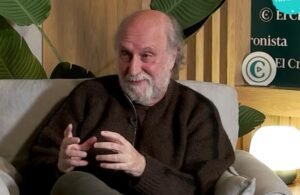
Santiago Motorizado, Eleven Songs That Spent a Decade in a Drawer

Santiago Motorizado, nombre artístico de Santiago Barrionuevo, lidera Él Mató a un Policía Motorizado y en 2025 publicó El Retorno, su primer álbum solista.
His name is Santiago Barrionuevo, but for more than twenty years almost nobody has called him that. As the leader, songwriter and singer of Él Mató a un Policía Motorizado, he fronted the alternative rock movement that emerged from La Plata in the early 2000s and eventually filled arenas without abandoning its independent logic. He draws the covers of his own records, co-founded a label, won a Gardel Award for the soundtrack to Okupas and, in 2025, released El Retorno, a solo debut built from songs that had been sitting in storage for more than a decade. Television makes him uncomfortable, he does not seek exposure and, even so, he went viral singing a Cristian Castro song.
La Plata as a method
When Santiago talks about the origins of the band, he does not mention musical influences but geography. The essence of the group, he says, is tied to La Plata: going out at night looking for shows, meeting musicians who shared the same affinities, absorbing what was being played there. The distance from Buenos Aires, where all the attention is concentrated, imposed different times, a different rhythm and different ambitions.
That periphery also produced a practical conviction: the project would be independent from day one, and that was never in doubt. They lived alongside self-managed, handmade ventures that inspired them, and that proximity taught them something he sums up without grandiosity: they too could put together a band with friends and try to record their songs on a cassette. Making things with few tools and little money is, for him, a direct mark of where he comes from.
That ecosystem eventually led to Laptra, the label they founded together with other bands from the city and that ultimately gave a name to an entire scene: La Plata indie.
Drawing as part of the work
The entire visual identity of Él Mató —the album covers, the concert posters— is his work. He has drawn since childhood, had a natural ability for the human figure and was told so in primary school, secondary school and at Fine Arts. But at some point he understood that drawing was a tool rather than an end in itself, and he found in the band the place to develop it.
There was also a reason tied to the era. In the years before Spotify, when you could not listen to a band instantly, something had to attract attention before the music did. The group’s name and those early posters, which broke with the visual standards of the scene, fulfilled that role.
Growing without realizing it
Él Mató reached places that, at first glance, do not seem part of independent culture, but Santiago insists there was never a sudden leap. Each album generated more anticipation than the previous one and the audience grew at a manageable pace, which meant they were well prepared when mass popularity arrived. The two Luna Park shows in September 2023, presenting Súper Terror, are the clearest illustration: historic concerts for the group that, in his view, simply mean there are a lot of people who want to see them.
The way they work did not change either. After the success of La Síntesis O’Konor, several people suggested they release another album quickly to take advantage of the attention. He understands the logic but does not share it: he believes that during the creative process you have to stay connected to what you actually want to say, and that thinking beyond that is a mistake. The audience’s response, he says, is something they look at afterward, once the album is already finished.
Súper Terror arrived with songs that were more pop musically and lyrics written during the development of the album, shaped by the pandemic without explicitly naming it: uncertainty, introspection and the abrupt break of the post-pandemic period, which left things unfinished. While writing, he says he experienced three feelings at the same time: melancholy, anger and a certain brightness, the kind that appears when something ends and something else begins.
The side he does not seek
Media exposure is something he consciously avoids. At one point the band gave television a red light: they did not want to appear unless it was on a specifically music-focused program. The explanation is simple and personal: cameras and the pace of television make him nervous and uncomfortable.
The paradox came from somewhere else. The episode that gave him the most exposure was not an album or a stadium show, but a viral video in which he sings “No podrás,” by Cristian Castro. Seeing the scene reproduced everywhere overwhelmed him somewhat and made him shy, although he took it calmly: after two decades of doing this, he says, he is ready for anything.
Okupas, the Gardel and music for the screen
Before his solo album, he had already explored working outside the band. He composed the music for the reissue of Okupas, Bruno Stagnaro’s series, on the album Canciones sobre una casa, cuatro amigos y un perro, which won a Gardel Award in 2022. He also worked on the soundtrack for La muerte no existe y el amor tampoco.
Those precedents make his solo debut less of a beginning than a formalization.
El Retorno: songs that waited ten years
El Retorno was released at the end of June 2025 with eleven songs that had been stored away for more than a decade. Many had circulated for years among friends and online, in homemade versions and live recordings, some of them even leaked. The album brings them back with new arrangements and a finished sound.
It was recorded at Sonic Ranch studios in Texas with brothers Felipe and Tom Quintans and producer Eduardo Bergallo, with whom Santiago had already worked during the days of La Dinastía Scorpio. It was released by Primavera Labels, the label associated with Primavera Sound.
The track list works like a map of his obsessions. “Camino de piedras” was born when he was listening to Iron & Wine and Devendra Banhart and felt like going out to play on his own; it began as guitar and voice and ended up with a western feel. “Amor en el cine” already had a connection with audiences despite never having been officially released. “Google Maps” —formerly “Google Earth”— turns the clumsiness of searching for someone in an app into a joke, and he believes it remains relevant because of that expectation that a phone should somehow solve existence itself. “No me trates mal” had been abandoned in 2012 when the band could not figure out what to do with it. “Pienso en vos” is a tribute to pop culture, with references to 69 Love Songs by The Magnetic Fields and the film known in Argentina as Hechizo del tiempo. “El pastor me dio su mano” tells the story of someone resentful who looks for answers in religion, and he adds the biographical detail: he had a religious education through primary school, was baptized, took communion and confirmation, and later became a punk.
There is also a cover: “Jazmín chino,” by 107 Faunos, which he describes as one of his favorite songs in the history of music. It had the approval of Gato himself, the driving force behind the band. He took the idea of including someone else’s song from the Ramones’ first album.
The album deals with the usual themes —love, friendship, sadness— but filtered through humor. The exception is “Te pido perdón,” which closes the album in a more melancholic tone, without a comic turn, and which he chose as the ending precisely because it opens a door to whatever comes next.
Maradona, Claudia and a campaign without a playbook
The album rollout involved an unconventional creative campaign. To preview “Google Maps,” Santiago grabbed his guitar, took the train and played an acoustic version for passengers at Castelar, Banfield and Turdera stations.
The second single, “La Revolución,” arrived with a music video he directed himself in which he reverses the roles of a real story: Maradona is played by actress Florencia Pereiro and Claudia Villafañe is played by Santiago himself. The video recreates scenes from Diego’s return to the national team, with a sentimental engine behind the story. The song was recorded between Buenos Aires and Texas and produced by Felipe Quintans, Eduardo Bergallo and Barrionuevo himself. He developed the visual side of the project together with Bohemian Groove Corp, the creative laboratory led by Dillom.
El Retorno was officially presented at the Teatro Gran Rex on September 4, 2025. By his own definition, the solo path does not replace the band: it runs alongside it.