Five years on stage and twenty countries: the story of Claudio Tolcachir
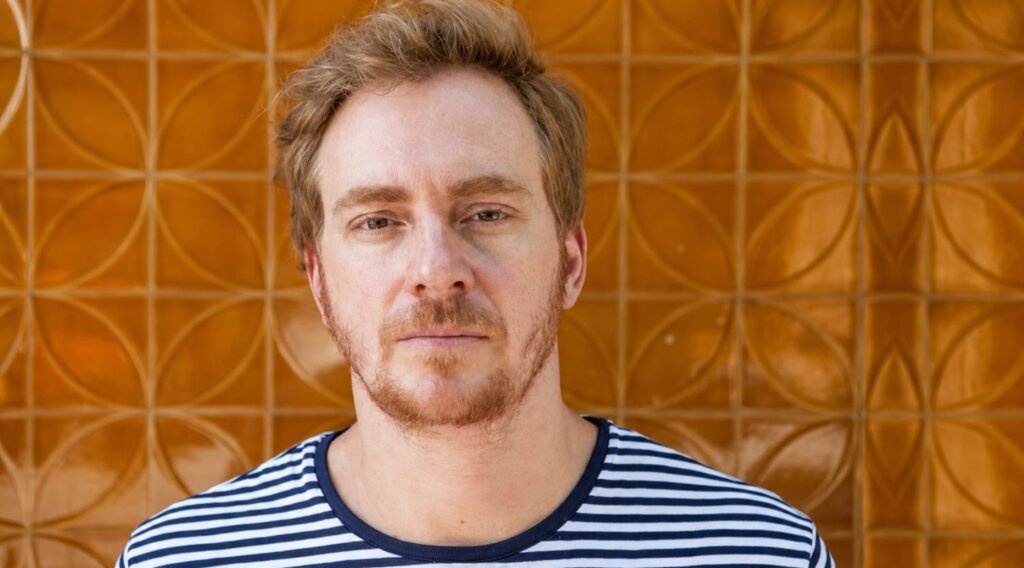
Claudio Tolcachir convirtió un pequeño espacio teatral de Boedo en Timbre 4 y llevó sus obras a escenarios de más de veinte países.
He built his first theater in the apartment next door to his home, in the middle of Argentina’s 2001 crisis. Out of that space came a play about a dysfunctional family that became an international phenomenon, eventually reaching nearly 2,200 performances in 24 countries. Today he directs at Madrid’s Centro Dramático Nacional, in commercial theaters in Buenos Aires, and at his own venue in Boedo, without seeing any contradiction among the three.
Assistant director at sixteen
Tolcachir’s training began early, with a teacher who shaped much more than his craft. He studied at the Labardén Institute and at Andamio 90, the school founded by Alejandra Boero, one of the central figures of Argentine independent theater. He became her assistant director while still a teenager. He later continued his training with Juan Carlos Gené and Verónica Oddó and worked as an actor in both independent and commercial theater.
What he says he learned from Boero was less a technique than a way of positioning himself in the world: an enormous passion for persuading people, defending actors’ rights, and opening theaters. That was where, in his own reading of his life, he acquired the commitment to self-management that would later define almost everything he did.
In 1994, his performance in Lysistrata earned him recognition as a breakthrough actor, an early distinction in a career that would eventually move increasingly toward directing and playwriting.
The apartment next door
Timbre 4 was born without a business plan and almost by necessity. During the economic crisis that devastated Argentina at the beginning of the century, Tolcachir created a theater space in a property connected to his home in Boedo, where he could teach, rehearse, and develop his own productions. He has said that he wanted to teach, write, and direct; he did not particularly want to own a theater. He ended up with one anyway.
There he staged Jamón del diablo, a free adaptation based on Roberto Arlt’s 300 millones. But the work that transformed his life was La omisión de la familia Coleman, which premiered on August 6, 2005. Tolcachir was both writer and director. The play emerged from months of improvisation and rewriting with the actors in his company and initially opened with very little promotion. Word of mouth changed everything.
By 2007, invitations to international festivals had begun arriving. What had started in a small Buenos Aires house became one of the most internationally successful works of contemporary Argentine theater. By 2026, the production had accumulated close to 2,200 performances and had been staged in 24 countries and dozens of international festivals.
Then came Tercer cuerpo, centered on the everyday lives of employees in a public office, and El viento en un violín, which premiered in France before being staged in Argentina. The works continued traveling internationally for years.
A director who does not turn his nose up at anything
The other half of his career has involved directing other writers’ work, and the list would confuse anyone looking for allegiance to a single theatrical school.
He directed Tracy Letts’s August: Osage County with Norma Aleandro, Arthur Miller’s All My Sons at Madrid’s Teatro Español, David Lindsay-Abaire’s Good People, and Florian Zeller’s The Lie. He also took on two large-scale musicals: Sunset Boulevard at the Maipo in 2018 and Cabaret at the Liceo in 2019. Sunset Boulevard became the major winner at Argentina’s 2018 ACE Awards, taking nine prizes, including best musical and best musical direction for Tolcachir.
His career has repeatedly connected him with Mercedes Morán, whom he regards as family, and with Imanol Arias, whom he first met decades earlier while working in film. In Spain, he has directed productions including La guerra de nuestros antepasados and numerous works that toured extensively around the country.
From Timbre 4, he has also maintained an international exchange between Argentine theater and companies and artists from abroad, preserving the venue’s original role as both theater and creative laboratory.
Los de ahí: writing again after seven years
In January 2025, Tolcachir premiered Los de ahí at the Teatro María Guerrero, one of the venues of Spain’s Centro Dramático Nacional. The play follows delivery riders who wait for a machine to assign them their next job while trying to survive in a foreign city whose language and codes they do not fully understand.
It marked Tolcachir’s return to playwriting after several years. The commission came from Centro Dramático Nacional director Alfredo Sanzol, who gave him something unusually valuable: a theater, a date, time to work, and freedom to decide what he wanted to tell.
Tolcachir has said that he is more interested in communities than in conventional plots, especially communities formed by people who did not choose one another but are forced by circumstance to coexist. In Los de ahí, that idea becomes a group of workers connected by an algorithm, economic necessity, and their status as outsiders.
Debates, friction, and a film that went wrong
In a career spanning decades, Tolcachir has generally avoided personal scandal. What he has accumulated instead are arguments about theater, culture, politics, and the economic conditions under which art is made.
The clash over cultural policy. In 2024 he became publicly critical of Argentina’s national government and of cuts affecting cultural activity. His position was openly political, but he also framed it through the practical economics of independent theater: venues depend on audiences being able to buy tickets and on an ecosystem capable of sustaining actors, technicians, teachers, and spaces.
Independent and commercial at the same time. For purists, the fact that one of the leading figures of Buenos Aires independent theater can direct an Andrew Lloyd Webber musical in a major commercial venue may seem contradictory. Tolcachir rejects that division. He has repeatedly described Timbre 4 as a place where he can move from experimental theater to a musical or a commercial comedy without treating one form as artistically superior to another.
A film debut that did not work. In 1998 he appeared in Buenos Aires me mata, directed by Beda Docampo Feijóo and starring a cast that included Imanol Arias, Fernán Mirás, Eleonora Wexler and Nancy Dupláa. The experience did not turn Tolcachir into a movie star, but it created relationships that would reappear decades later.
Years later he returned to cinema with Mentiras piadosas, based on stories by Julio Cortázar, while his international reputation as a theater director was already firmly established.
He also had to fight for the material survival of theater itself. During the pandemic, Tolcachir warned that reopening independent venues with extremely restricted capacity meant operating at a loss. Timbre 4 could use one room for only 12 spectators under the regulations then in force, while utility bills and other operating costs continued to accumulate. Even so, he argued that reopening mattered because the theatrical ecosystem needed to start moving again.
The awards, and what they do not measure
The Konex Foundation has recognized him three times. He received a Diploma of Merit in 2011 as one of Argentina’s leading theater directors of the decade, another Konex distinction in 2014 for playwriting, and the Platinum Konex in 2021 as the decade’s outstanding theater director.
In 2012, the Buenos Aires Legislature officially declared him a Distinguished Personality of Culture. His career also includes ACE, María Guerrero, Teatro del Mundo, Clarín, Max and Ubu distinctions and nominations.
None of those awards, however, measures what Tolcachir himself identifies as his real education.
When he talks about his teachers, after figures such as Alejandra Boero and Norma Aleandro, he names the people with whom he built Timbre 4. The point is not sentimental. He sees theater as something learned shoulder to shoulder, through rehearsal rooms, disagreements, mistakes, performances, and years of working with the same people.
Above them all, he often places his mother, a scientist whom he has described as one of the freest and most curious people he knew.
His definition of the craft is equally grounded. He wants life onstage rather than formality. He dislikes seeing the machinery of intention: the obvious attempt to move an audience, make it laugh, teach it something, or demonstrate the importance of an idea.
For Tolcachir, demanding that a character behave coherently is almost a way of killing that character, because human beings are not coherent creatures. They contradict themselves.
That may be the simplest explanation for why his theater can work in Boedo, Madrid, Paris, or an international festival without having to change its emotional language.