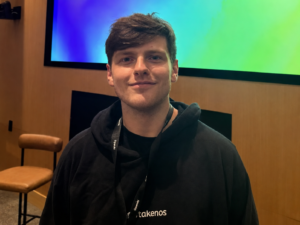
Santiago Sosa, the Argentine who took a platform across Latin America

Santiago Sosa cofundó Tiendanube cuando todavía era estudiante y convirtió el proyecto en una plataforma de comercio electrónico utilizada por más de 180.000 marcas en América Latina.
The first investors were his parents and the parents of his partners. They were nineteen or twenty years old, and the investment they needed came down to a computer, food and a roof over their heads. They did not pay themselves a salary, and they did not need one. Fifteen years later, Santiago Sosa leads more than a thousand people at a company valued at over $3 billion, operating in seven Latin American countries and powering more than 180,000 brands. He has never worked for another company. The only exception was a three-month internship in India that he himself describes as a summer adventure.
A marketplace that did not work
The company Sosa runs today did not start out as what it is now.
It began as Linkedstore, a marketplace run by a group of friends and classmates from ITBA. The idea was to bring sellers together in one place, which was what everyone was doing at the time.
Over time, they discovered something else. Sellers did not want to be displayed in someone else’s storefront: they wanted their own storefront, with their identity, their name and their own way of presenting products.
That shift gave rise to Tiendanube, after the project went through Baitec, the Buenos Aires city government’s incubation program.
Sosa talks about those beginnings without idealizing them. He says the first major obstacle was neither technical nor commercial: it was going from being four Computer Engineering students to four entrepreneurs who suddenly had to deal with problems far beyond anything they had been trained for.
Ten years of pushing forward
There is one phrase of his that frames the entire story, something he said after he was already the CEO of a unicorn: today investors come to them, but their story is much more about struggling their way forward.
The details of that period confirm it. The project began as a university hobby, although with the stated intention of turning it into a business. The first contributions came from their families. There were no salaries. The cost structure consisted essentially of one computer per person.
Only once they began adding customers and validating that there was a real business thesis behind the project did the first genuine investment arrive, and even that came in several installments.
Along the way, Sosa accumulated an unusual distinction for someone in his position: he has never been an employee. His only experience inside another organization was that three-month internship in India, which he completed with Martín Palombo, now the company’s chief product officer.
What changed in 2020
If there was one moment that divided Tiendanube’s history into two eras, it was the pandemic.
Thousands of businesses that had never sold online suddenly had to do so overnight or close. The platform went from 20,000 to 90,000 customers in a year and a half.
Sosa often explains the scale of the market shift with one figure: when they started, e-commerce penetration in the region was around 0.5%; a decade later, it had reached 10%.
That growth also changed the company’s revenue model. Previously, subscriptions represented around 75% of revenue. As transaction volumes increased, the split moved closer to fifty-fifty between subscriptions and transaction fees.
The $500 million and the leap into another league
In August 2021, Tiendanube closed a $500 million Series E round co-led by Insight Partners and Tiger Global Management, with participation from other major funds.
It was the largest private investment in an Argentine company up to that point and the third-largest deal in the region that year, surpassed only by two Brazilian transactions. The company was valued at more than $3.1 billion and became the fifth most valuable startup in Latin America.
There was a coincidence Sosa found particularly striking: only weeks earlier, the same two funds had turned Mural into a unicorn, whose founders were angel investors in Tiendanube.
His description of the moment was straightforward. That year, he said, the company was moving into another league, a much more international one.
The expansion plan, country by country
This is where Sosa’s path becomes more specific and distinct from that of the company’s other founders.
The capital they raised had three destinations, and he listed them clearly. First, improve what they were already doing and raise the level of service. Second, expand the application ecosystem, which already included more than three hundred public and private apps. Third, accelerate an international expansion that had already been planned.
The map unfolded in stages. Brazil and Mexico came first, with the brand operating as Nuvemshop and the company opening offices in São Paulo. Colombia followed toward the end of 2021. Chile and Peru came in 2022. Uruguay was added as well.
The logic behind the expansion was not simply to plant a flag and wait. In each market, the company built local operations and developed its own data. Today, for example, it publishes separate editions of its annual report for Argentina, Brazil, Mexico and Chile, each containing analysis specific to that market. In Chile, the fastest growth in new stores during 2026 occurred outside the metropolitan region, in Maule, Coquimbo and Biobío.
That level of regional detail is largely the result of building actual operations rather than merely translating the platform.
A company that became a source of data
One move by Sosa has delivered more value than it might initially appear, and few competitors have replicated it: turning information from the platform itself into a public annual report.
NubeCommerce has now reached eleven editions and has become a reference for the sector. It draws on data from more than 180,000 brands and ultimately helps shape the conversation around Latin American e-commerce.
It is a two-sided strategy. On one hand, it gives merchants a real planning tool. On the other, it positions the company as an authoritative voice on the market in which it competes.
Figures from the first half of 2026 in Argentina give a sense of the scale involved: stores operating on its technology generated more than 1.2 trillion pesos in sales, with twelve million purchase orders and 56 million products sold.
The numbers also show something less comfortable, which the company itself disclosed rather than hiding: growth is being driven more by volume than by price, and among brands that were already selling the previous year, the average ticket increased at a rate below inflation.
How he thinks about his job
When asked about obstacles, Sosa says there have been many and that there are new ones every day, because that is what entrepreneurship is about.
His stated method is notably unromantic: take a critical position, identify the two or three issues that matter most to customers and solve them. He talks about problem-solving before vision.
He repeats the goal that defines the company in every public appearance: lowering the barriers to entrepreneurship. It sounds like corporate copy until you look at who the company actually serves. Half of its initial customers were Argentine SMEs, and today much of the ecosystem consists of small businesses that would otherwise have no practical way to sell online.
His advice to people starting out, given while receiving an award, is the kind that ages well: when desire, ideas and enthusiasm are combined with perseverance, hard but intelligent work, good teams and a real need to solve, it is worth following that instinct. And if the opportunity exists, it is worth trying even if it does not work out, because there will always be another opportunity.
What comes next
In 2025, Sosa joined the Endeavor network together with Palombo and Vázquez after an international selection panel in which they presented their story and vision to global business leaders.
The environment he faces now is considerably more competitive than it was during the pandemic. International platforms such as Shein and Temu have rapidly gained ground across the region and are putting pressure on local brands. The company’s response centers on installment financing, delivery speed and the use of artificial intelligence in customer service, recommendations and transaction completion.
It is the third major change in the environment he has had to manage: first a market that barely existed, then one that exploded almost overnight, and now one that is becoming more professional and increasingly crowded with global players.
All three found him in the same place. It is still the only job he has ever had.