Anne Carson: The Classicist Who Learned Greek at Lunchtime and Won the 2026 Nobel Prize in Literature
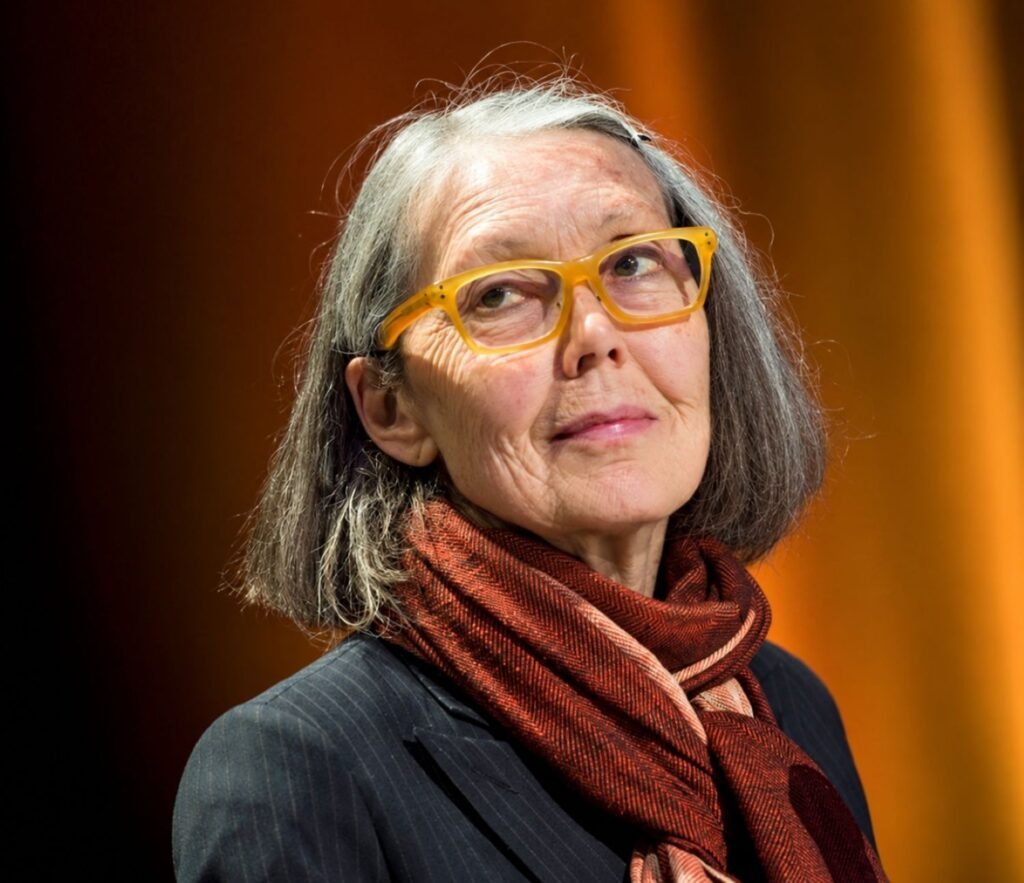
Anne Carson combina poesía, ensayo, traducción y teatro en una obra que dialoga con la tradición clásica.
She learned ancient Greek in secondary school, during breaks, because a Latin teacher offered to teach her over lunch. She completed her doctorate on Sappho, spent seven years at Princeton without securing tenure, and later taught at Michigan, in New York, at McGill, Cornell, Stanford and Bard. In between, she published more than twenty books that no bookstore quite knew where to put, because they are simultaneously poetry, essays, translation and theater. On October 8, 2026, the Swedish Academy awarded her the Nobel Prize in Literature. She was in Iceland, and her reaction, given to a radio station there, was a single word: “Crazy.”
Ancient Greek at Lunchtime
The origin of her entire body of work is a fairly modest school scene.
Carson was born in Toronto in 1950 and grew up in small Ontario towns because her father worked at a bank and was transferred from place to place. In secondary school, she met a Latin teacher who offered to teach her ancient Greek during lunchtime. That was how it began.
From there, she went to the University of Toronto, where she graduated in 1974, earned her master’s degree in 1975 and completed her doctorate in 1981, with a dissertation on Sappho. She also spent a year at St Andrews in Scotland.
That training explains something worth understanding before reading her: for her, Greek is neither a cultured ornament nor an appeal to authority. It is the language she works in. When she brings Sappho into conversation with Emily Brontë, or Thucydides with Virginia Woolf, she is not playing a game of references; she is reading both in the original and noticing a resemblance.
The Woman Who Did Not Get Tenure at Princeton
Her academic career bears a scar worth recounting because it explains part of her later freedom.
She began teaching at the University of Calgary in 1979 and joined Princeton in 1980, where she spent seven years without receiving tenure. She left in 1987. She then taught at Emory, returned to Canada to direct graduate studies in Classics at McGill, where she became a full professor, and from that point her résumé becomes a list of institutions: the University of Michigan between 2003 and 2009, NYU from 2009, Cornell between 2010 and 2016, Stanford in 2013 and Bard from 2014.
A Classics department that did not retain her in the eighties was applying its own criteria, and viewed today, the episode becomes an anecdote about the limits of those criteria. The person who was denied tenure ended up with the Nobel, and precisely what made her difficult for an academic committee to classify was what the Swedish Academy ultimately rewarded.
A Book Claimed by Three Disciplines
Eros the Bittersweet, published in 1986, is her first book and the best example of the problem her work creates for anyone who has to place it on a shelf.
It emerged from her academic work on desire in Greek literature. Classics specialists read it first and regarded it as a contribution to their field. The nonfiction world then adopted it as an essay. Finally, poets claimed it and read it as poetry.
All three readings were correct, and that is the point. Carson writes books that are several things at once: poetry, essays, criticism, dramatic dialogue, verse narrative and translation. Autobiography of Red, published in 1998, is a verse novel about a monster from Greek mythology who becomes a teenage boy with red wings in the book. The Beauty of the Husband, published in 2001, is a long narrative poem about a marriage falling apart, structured in twenty-nine tangos.
For a publishing industry that needs one category per book, that is a complication. For readers, it is the contribution. Awards confirmed it in their own way: in the same year, 2001, she won the Griffin Poetry Prize for one book and the T. S. Eliot Prize for another, becoming the first woman to receive the latter.
Translation or Rewriting?
Here lies the most contentious debate her work has generated, a real and unresolved discussion of the kind that deserves explanation rather than avoidance.
Carson translated ten Greek tragedies by Aeschylus, Sophocles and Euripides, as well as Sappho’s poetry. But her translations do not resemble those of a philologist seeking line-by-line fidelity. Antigonick, her 2012 version of Sophocles’ Antigone, is handwritten, illustrated by Bianca Stone on translucent pages, and allows itself anachronisms, cuts and annotations absent from the original.
The reaction was predictable. Much of the Classics community debated whether it was a translation or a new work using the Greek text as material. The question even became an academic title: university papers exist that are literally called “Anne Carson’s Antigonick: Translation or Rewriting?”
What is interesting is how the debate was settled, at least institutionally. In awarding her the Nobel, the Swedish Academy treated her translations as independent works, valuable in their own right for the creative freedom with which they were made. What had been criticized for years as excess was named a merit.
And there is a philological argument in her favor that often gets lost in the discussion. When translating Sappho in If Not, Winter, Carson leaves the gaps visible: the papyri survived in fragments, with missing words, and instead of completing them, she prints empty brackets. Readers see exactly what the text has lost. It is more faithful to the actual state of the material than any version that fills the holes.
Nox, Which Is a Box
In 2010, she published a book that is not easy to lend.
Nox is a facsimile of a notebook she assembled after the death of her brother Michael, who had left Canada and disappeared from her life for twenty-two years. The book comes in a box, unfolds like an accordion and reproduces clippings, photographs, stamps, stains, brushstrokes and her own handwriting, interspersed with a translation of Catullus’ poem 101, which the Latin poet wrote for his dead brother.
It is not a design object. It is the form she found for a grief about which she had little information: when someone leaves and does not return, what remains is disordered material, and the book reproduces it as it is.
That is not the only time her life has entered her texts, although she discourages autobiographical readings. Her father’s Alzheimer’s appears in her work. Her mother died while she was writing Men in the Off Hours, which won the Griffin in 2001.
Awards and Silence
The list is long and began early: Lannan in 1996, Guggenheim in 1998, the MacArthur Fellowship in 2000, the two Griffin awards in 2001 and 2014, the T. S. Eliot in 2001, the Order of Canada in 2005, the Princess of Asturias Award for Literature in 2020, the Governor General’s Award that same year, the PEN/Nabokov in 2021 and the Vigdís Prize in 2023.
Alongside this, she developed a fairly strict policy of privacy. She gives few interviews, does not explain her books and is famous for the tiny author biographies she gives her publishers, one or two lines saying she was born in Canada and teaches ancient Greek for a living.
She is married to the artist Robert Currie, who participates in several of her projects and collaborates on the visual construction of her books and stage works. In 2022, they both obtained Icelandic citizenship.
October 8, 2026
The announcement found her in Iceland, and the Swedish Academy’s permanent secretary, Ingrid Carlberg, said she was very surprised. Icelandic broadcaster RÚV managed to speak to her, and all she said was “Crazy.”
The jury’s citation honors her bold and inventive work, which, in playful dialogue with the classical tradition, has created new forms for contemporary literature. The explanation highlighted her method of bringing voices from different eras into conversation until they produce a kind of double vision. The prize is worth 12 million Swedish kronor, around 1.2 million dollars, and the ceremony takes place on December 10 in Stockholm.
The award comes during a period she herself made public. In August 2024, she wrote in the London Review of Books that she had been diagnosed with Parkinson’s disease. She wrote without dramatics and without asking for anything, in the same register she has used since 1986, and did so in the same year she published Wrong Norma, her most recent book.
At 76, she remains, according to her own description of her occupation, someone who teaches ancient Greek. What has changed is that the committee that honors the world’s writers has now decided that this way of reading the dead was a new way of writing.