Tom Hulce: from acting virtuosity to creative architecture on Broadway
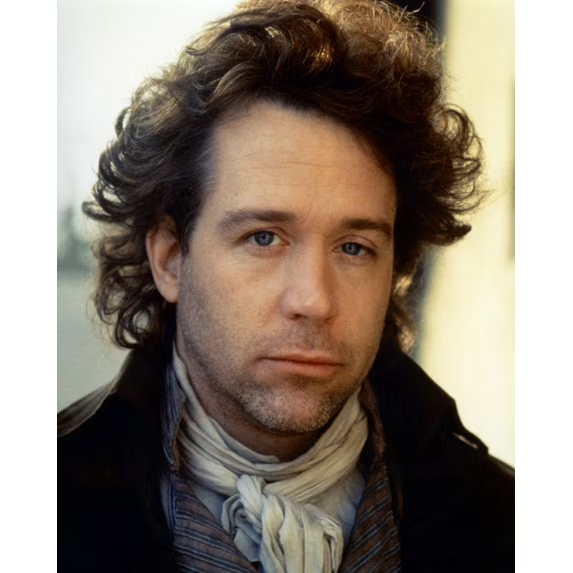
El actor Tom Hulce en su interpretación de Mozart en Amadeus
The trajectory of Tom Hulce is shaped as an atypical path within the entertainment industry. His development does not follow a logic of constant on-screen presence, but rather an evolution toward spaces of greater creative control. From film acting to theatrical production, his profile combines interpretive technique with cultural management capabilities.
Education and early years
Hulce’s professional beginnings are grounded in his training at the University of North Carolina School of the Arts, where he acquires a solid foundation in classical acting. This type of training integrates voice, body, and text analysis—essential elements for building complex characters. His work in theater allows him to develop expressive precision and stage control, skills later transferred to film.
Breakthrough in film
His initial visibility comes with National Lampoon’s Animal House, a production that redefines the college comedy genre in the United States. Within this context, Hulce portrays a character that functions as a narrative anchor amid collective chaos. The film establishes a new comedic code and positions him as an actor adaptable to diverse registers.
Recognition with Amadeus
The peak of his recognition arrives with Amadeus, directed by Miloš Forman. His portrayal of Wolfgang Amadeus Mozart is constructed through a non-conventional approach, moving away from traditional solemnity. The performance combines intensity, emotional instability, and technical rigor, earning him an Academy Award nomination for Best Actor.
Interpretive diversification
Following the impact of Amadeus, Hulce participates in projects such as Parenthood, where he explores family dynamics through a more grounded register. This stage highlights his ability to move across genres without losing interpretive consistency. At the same time, he avoids overexposure, opting for a more selective and focused project trajectory.
Exploration in voice acting
His work in The Hunchback of Notre Dame introduces a distinct technical dimension: voice acting. In this format, Hulce constructs the character of Quasimodo through nuances in intonation and rhythm. Voice performance requires conveying emotion without visual support, expanding his professional range within the industry.
Transition to production
From the late 1990s onward, Hulce redirects his career toward theatrical production on Broadway. This shift implies moving from artistic execution to project coordination. His role includes financial structuring, creative selection, and positioning works within the cultural market, consolidating a second professional stage.
Broadway production
Among his most relevant works is Spring Awakening, a production that combines narrative innovation with commercial impact. Theater production requires interpreting audience trends, managing multidisciplinary teams, and balancing creative risk with economic viability. Hulce positions himself as a key actor in this process.
Decisions and controversies
The reduction of his on-screen presence at the peak of his recognition generated varied interpretations within the industry. This decision can be understood as a strategy aimed at preserving artistic autonomy. Rather than maintaining continuous visibility, he prioritizes involvement in projects where creative control is decisive.
Legacy and positioning
Hulce’s contribution operates on two levels. On one hand, his performance in Amadeus continues to be analyzed for its technical complexity. On the other, his work as a producer reflects a comprehensive understanding of the cultural ecosystem. His trajectory redefines the concept of success, shifting from visibility toward influence within the creative process.