Maya Angelou: literary architecture of identity and memory
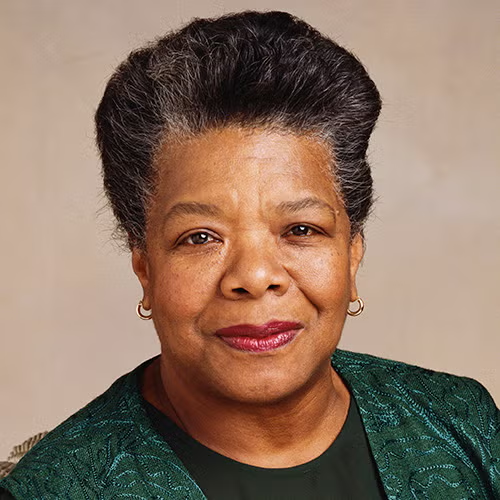
Maya Angelou desarrolló una obra que integra autobiografía, poesía y análisis social.
The trajectory of Maya Angelou can be understood as a narrative construction in which personal experience and collective history converge. Her work redefined autobiography by transforming it into a tool for cultural analysis, incorporating social, racial, and political dimensions within a sustained and structured framework.
Formation of a literary voice
Angelou’s childhood was marked by experiences that later shaped her narrative structure. A prolonged period of silence functioned as an intensive phase of linguistic observation. Rather than limiting development, this process enabled a precise and analytical relationship with language. Her later writing reflects rhythmic control, semantic clarity, and a capacity for synthesis linked to that formative stage.
Professional trajectory and cultural exploration
Before establishing herself as an author, she worked in music, theater, and journalism. Her international experience, including time in Africa, expanded her cultural perspective. This diversity is reflected in a body of work that avoids narrow local frameworks. Her career is not linear but cumulative, integrating multiple practices into a coherent narrative system.
Innovation in autobiography
With the publication of I Know Why the Caged Bird Sings, Angelou introduced a form of autobiography that combines personal narrative with structural analysis of society. The continuation of seven autobiographical volumes creates an extended narrative system. This approach redefined the genre by incorporating historical, racial, and gender variables while maintaining an individual perspective.
Poetic production and expressive structure
Her poetry is characterized by conceptual clarity and economy of language. In works such as And Still I Rise, she constructs a voice that articulates resistance and identity affirmation. Rhythm and repetition operate not only as aesthetic devices but as mechanisms of discursive reinforcement. Orality plays a central role in conveying meaning.
Engagement with civil rights
Angelou maintained connections with figures such as Martin Luther King Jr. and Malcolm X. Her involvement included organizational and communicative work. This experience informs a body of work where political dimensions are embedded structurally rather than presented as explicit slogans.
Institutional recognition
She was awarded the Presidential Medal of Freedom by Barack Obama in 2010. She also participated in the 1993 inauguration of Bill Clinton, where she delivered an original poem. These milestones extended her presence into institutional and public spheres beyond literature.
Debates and critical reception
Some of her works have faced challenges in educational contexts due to their explicit treatment of racism and violence. These debates reflect the capacity of her writing to intervene in broader cultural discussions. The inclusion of her texts in academic programs has contributed to revising traditional literary canons and incorporating new perspectives.
Legacy and projection
Angelou’s work continues to function as a reference in cultural and literary studies. Its integrative approach enables the analysis of historical processes through subjective experience. The persistence of her influence lies in the capacity of her texts to operate as tools for social interpretation across different generational contexts.