Agatha Christie: engineering of literary mystery
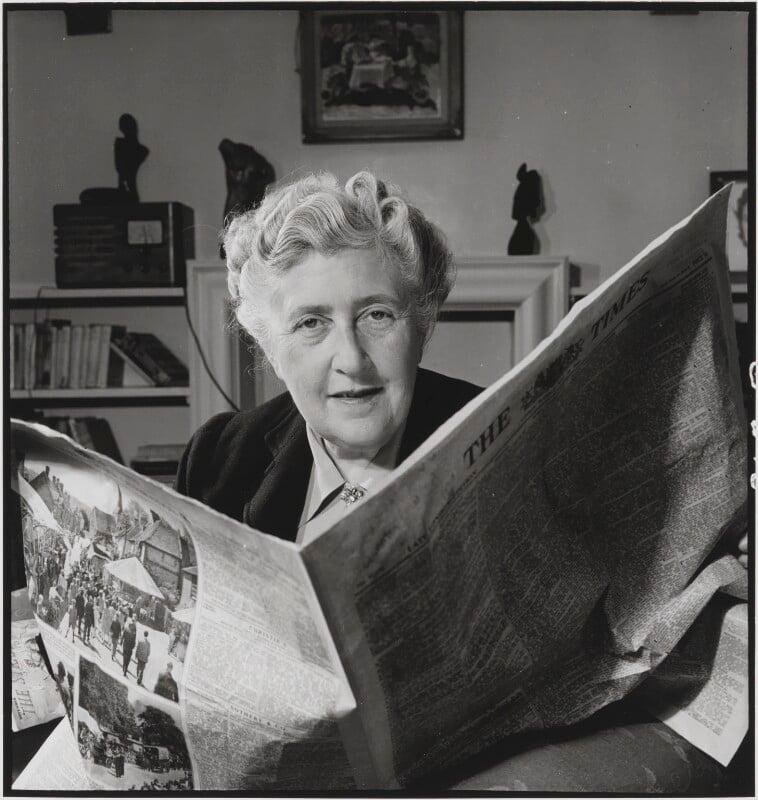
Agatha Christie, autora británica que estructuró el modelo moderno de la novela de misterio.
The trajectory of Agatha Christie is structured around a precise narrative logic focused on constructing sustainable enigmas. Her work not only consolidated the detective genre but also established replicable models based on information management, rhythm control, and the manipulation of reader expectations. This structural clarity explains her enduring editorial relevance and global reach.
Training and early years
Her childhood in Torquay unfolded within a home-based educational environment, where reading functioned as the central formative tool. This context enabled early assimilation of classical narrative structures. During World War I, she worked in healthcare, acquiring knowledge of chemical compounds that later informed her plots, adding technical precision to the mechanisms of crime.
Literary consolidation
Initial recognition came with The Mysterious Affair at Styles, where she introduced Hercule Poirot as a model detective grounded in deductive logic. Unlike earlier figures, his method relied on systematic analysis of clues. The later creation of Miss Marple expanded the narrative framework, incorporating resolutions based on social patterns and observation of everyday human behavior.
Narrative method
Her works are built on a structured design in which each element fulfills a specific role within the enigma. Clues are distributed in a controlled manner, avoiding arbitrary resolutions. The use of unreliable narration and multiple suspects sustains tension throughout the text. The resolution reorganizes available information, producing a complete reinterpretation of the narrative.
Production and scope
Christie’s body of work includes more than sixty detective novels, along with short story collections and plays. Titles such as And Then There Were None introduce closed systems in which the number of characters progressively decreases. This device intensifies tension and reduces narrative variables, forcing an internal resolution within the established structure.
The 1926 episode
Her eleven-day disappearance in 1926 generated significant media attention. The episode occurred during a period of personal crisis, linked to the death of her mother and the separation from Archibald Christie. From a retrospective perspective, it is interpreted as a moment of emotional strain. The event did not interrupt her production but increased her public visibility.
Second phase and expansion
Her relationship with archaeologist Max Mallowan introduced new settings into her work. Travels to the Middle East are reflected in novels set in archaeological contexts, where physical space becomes integrated into the structure of the crime. This phase expanded her repertoire while maintaining her established narrative logic.
Recognition and legacy
In 1971, she was appointed Dame Commander of the British Empire, recognizing her literary contribution. Her work has been translated into numerous languages, ensuring sustained global circulation. Beyond sales volume, her significance lies in the formalization of the detective genre, establishing narrative conventions that remain operational.
Contemporary relevance
Recent audiovisual adaptations have reactivated her catalog, confirming the stability of her narrative structures. Current interest is not limited to historical value but is sustained by the effectiveness of her mechanisms. Christie developed a system for constructing mystery that retains functionality regardless of cultural context or medium.