He asked a former Amazon chief to mentor him: Matías Viel’s bet
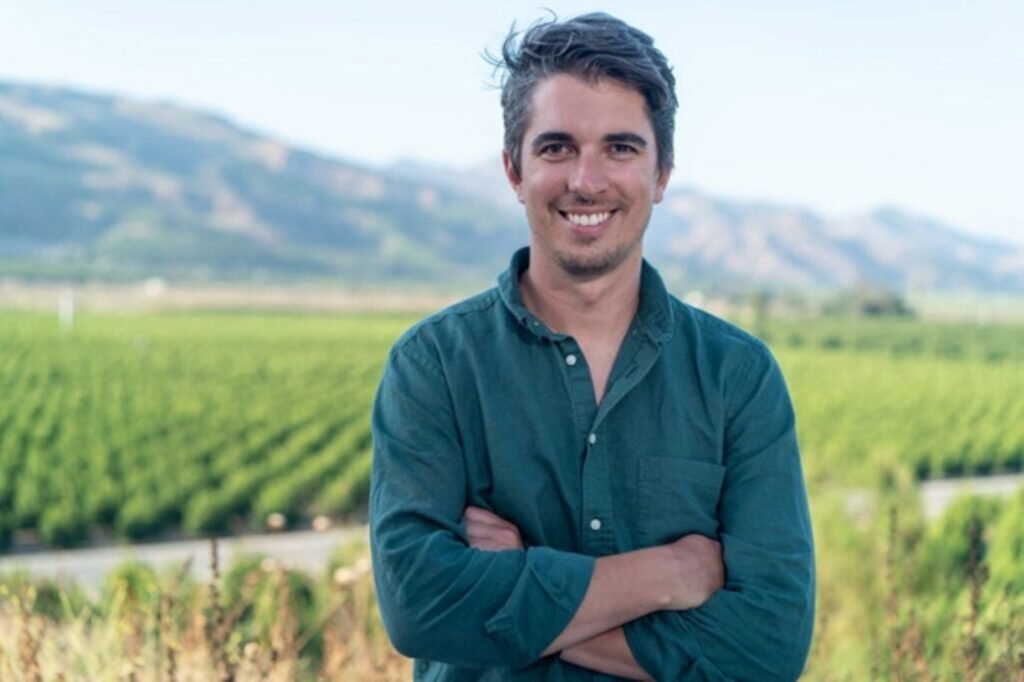
Matías Viel fundó Beeflow para aplicar ciencia y tecnología a la polinización de cultivos, con operaciones en seis países y desarrollos surgidos de laboratorios argentinos.
Pollination supports around 70% of the world’s crops, yet until recently almost nobody measured it. Farmers rented beehives, placed them in their fields and trusted the bees to do their job. Nobody calculated how many kilos per hectare that work produced, how many bees were actually needed or whether they were visiting the right flowers.
Matías Viel spotted that gap in 2016, when he was still living in Argentina and had no scientific background. Ten years later, he runs Beeflow from Los Angeles, serves more than fifty agricultural companies in six countries and counts among his investors the man who built Amazon’s retail business alongside Jeff Bezos. The story that stretches from a kiwi field in Mar del Plata to lunches in Santa Barbara is built largely on cold calls and Argentine science that had been sitting unused in a drawer.
From Balseiro to the other side
Viel graduated with a degree in Business Administration from Universidad de San Andrés. Before Beeflow, he worked at Despegar, at a car-sales startup in Brazil and at digital marketing agency Bullmetrix. Nothing in that path suggested that he would eventually build a biotechnology company.
The shift came through Matías Peire, founder of Grid Exponential, a company builder that brings scientists and entrepreneurs together to create science-based businesses. The relationship introduced Viel to a world he knew little about and showed him something he would later repeat in interviews: Argentina had technologies patented by CONICET that nobody was licensing. The knowledge already existed; what was missing was someone willing to turn it into a product.
During 2016, he traveled through Río Negro, Tucumán, Mendoza and Entre Ríos talking to farmers. The answer was remarkably consistent: everyone considered pollination critical, but nobody managed it professionally.
Two technologies from Argentine laboratories
Beeflow’s product relies on technologies licensed exclusively from Argentine research institutions. The first, developed by CONICET together with the National University of Mar del Plata, is a plant-derived molecule fed to bees. It strengthens their immune system and allows them to work at lower temperatures, when they would normally remain inside the hive. That matters for crops such as blueberries flowering in August in Tucumán or almonds in Mendoza.
The second technology addresses a different and subtler problem: bees get distracted. If a blueberry field sits next to eucalyptus trees offering more nectar, the bees may head for the eucalyptus and leave the crop without the pollination it needs.
To solve that problem, Viel partnered with Walter Farina, a researcher at the University of Buenos Aires and CONICET who has spent more than twenty years studying how bees learn and remember.
The mechanism is reminiscent of Pavlov’s dog. Bees navigate partly through floral scents, so the team reproduced those fragrances and incorporated them into food. The bee associates the smell with a reward and, once it leaves the hive, looks for the crop carrying the same scent. That line of work is developed through ToBee, a company owned by Beeflow.
A kiwi field and a phone directory
The first real test took place on a kiwi farm in Mar del Plata. Viel handled everything, from managing the hives to feeding the bees. Production rose by more than 40%.
With that result, he applied to IndieBio, one of the world’s leading biotechnology accelerators, based in San Francisco. No Argentine company had participated before, so the odds were not particularly good. He got in anyway, at the end of 2017, with a US$200,000 investment.
What followed was much less glamorous. Viel arrived in California without contacts or an investor network and found himself facing a conservative agricultural industry. His method was to pick up a directory of companies and start calling. He contacted more than one hundred growers asking for meetings despite knowing no one. Most never answered or said no. A few agreed, and over the years several of those early contacts became customers and even investors.
The scale argument was hard to ignore: Argentina has roughly 2,000 hectares of almonds; California has about 300,000.
How he reached Jeff Wilke and Steve Jurvetson
In 2018, Beeflow closed its first US$3 million round, led by New York-based Ospraie Management, and opened an office in Los Angeles. In 2021 came an US$8.3 million Series A led by Ospraie Ag Science, with participation from Vectr Ventures, SOSV and Grid Exponential. Altogether, the company has raised more than US$15 million.
Two names appear repeatedly among its investors: Jeff Wilke, the former CEO of Amazon Worldwide Consumer who built the company’s retail business alongside Bezos, and Steve Jurvetson of Future Ventures, who has served on the boards of Tesla and SpaceX.
Viel’s relationship with Wilke did not begin with an investment pitch. He met him in 2021 through other investors and made a much smaller request: he asked Wilke to become his mentor and meet for coffee every three months. Only after that relationship had been built did he mention that Beeflow was raising capital.
Since then, every quarter Viel travels the roughly 150 kilometers between Los Angeles and Santa Barbara to have lunch with him. He says the mentorship taught him how to design an organization that can scale, think bigger and manage relationships with investors and boards. He sums it up as learning how to play the venture capital game.
What Beeflow sells and what it delivers
Beeflow designs and runs pollination programs. It measures pollination, determines how many bees per hectare a crop needs and applies its proprietary technologies.
Compared with conventional pollination, the company reports productivity increases ranging from 10% to 40%, with some cases reaching 90% in specific Argentine crops, along with a 70% reduction in hive mortality.
Its molecules are patented in the United States, Europe, China, Australia, Argentina and Chile. The crops it works with include blueberries, almonds, cherries, avocados, raspberries, oranges, coffee, kiwis and, in Brazil, soybeans. Customers include Driscoll’s, the world’s largest berry producer, and Woolf Farming, one of the major almond growers.
The United States is Beeflow’s main market, with operations focused on California, Oregon and Washington and a recent expansion into New Jersey. The company has 28 permanent employees and grows to almost 80 people during agricultural seasons.
The Argentine chapter is now mainly scientific
There is one point Viel does not avoid: Beeflow is no longer commercially active in Argentina. The company operated there from its beginnings in 2016, working with blueberry growers in Tucumán and Concordia, almond producers in Mendoza, cherry growers in Río Negro and Neuquén and kiwi farms in Mar del Plata. It also held a two-year contract with BASF’s seed division.
Viel attributes the commercial withdrawal to conditions in Argentina’s agricultural sector. In recent years, he argues, local producers found it difficult to adopt innovation while trying to survive economic instability. He believes some normalization is underway, although he does not give a date for returning. Within two years, he says, the picture could be clearer.
What Beeflow has kept in Argentina is the technical heart of the company. The country hosts its research and development center and a service center supporting its other operations. Viel’s argument is straightforward: Argentine scientific knowledge is the asset Beeflow exports to the world.
That same interest led him to propose to business leaders including Hugo Sigman, Federico Trucco and Graciela Ciccia the creation of a startup space within the Argentine Chamber of Biotechnology. When he first proposed it roughly eight years ago, there were fewer than ten companies in the field in Argentina. Today there are close to 150.
His view of science funding has two sides. He strongly defends the quality of Argentine researchers, while also arguing that the country still needs a stronger bridge between scientific knowledge and the economy, with greater private-sector participation in the research system.
The unexpected mention in The Economist
In January 2026, Beeflow was mentioned in a The Economist column signed by Javier Milei and Federico Sturzenegger about regulation and business competition. Viel learned about it from messages that started arriving from investors in the United States and Europe. One told him he had been walking his dog and listening to the column when he suddenly heard the company’s name.
Viel’s public reaction was restrained. He described it as an enormous recognition and added that the team’s priority was to keep its feet on the ground. A couple of years earlier, he had already experienced another moment of local visibility when he was invited to Foro Llao Llao, the annual gathering of leading Argentine business figures.