Nicolás D'Auro: 1,500 restaurants and a database nobody was using
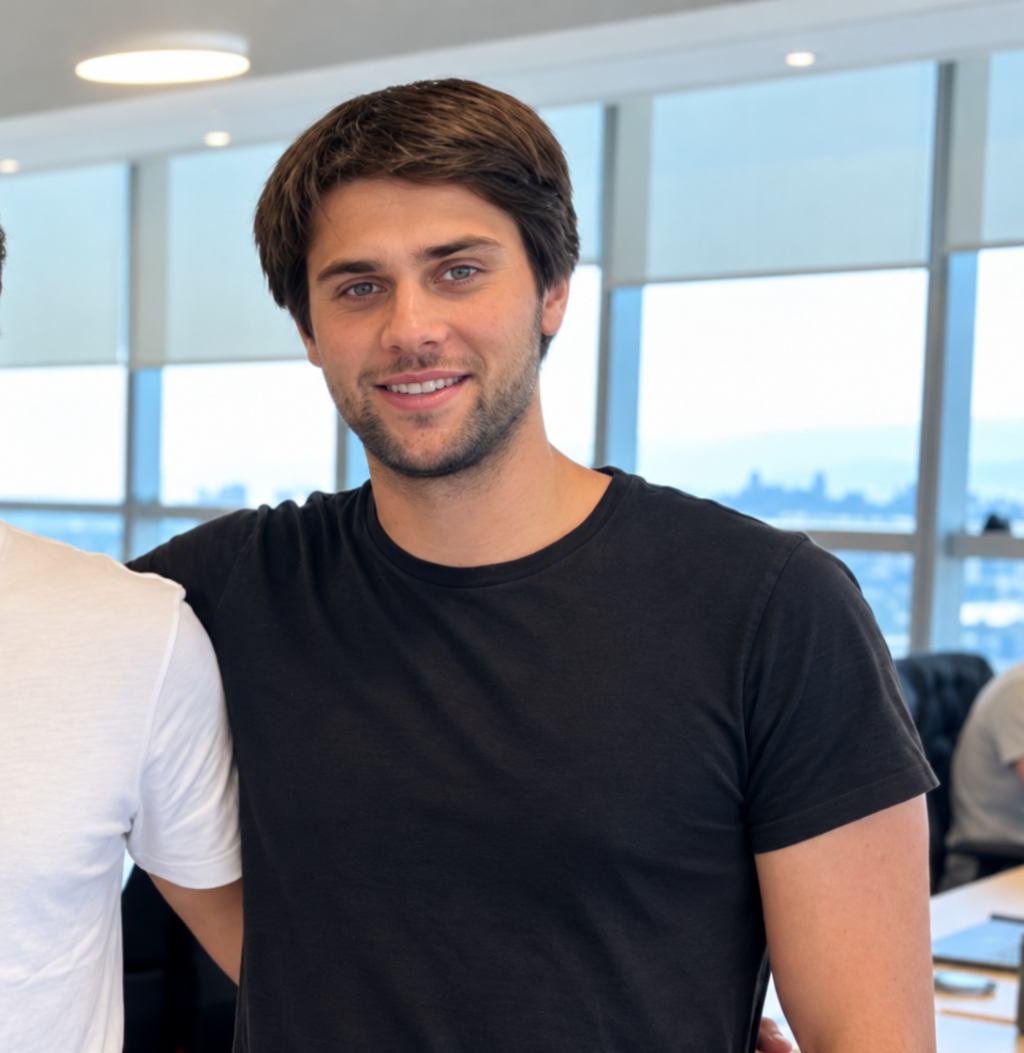
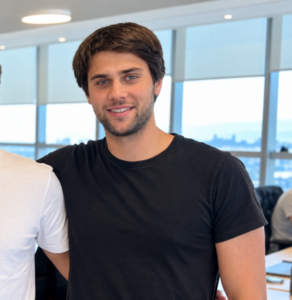
Nicolás D'Auro pasó de estudiar Ingeniería Nuclear en el Instituto Balseiro a cofundar Woki, una plataforma utilizada por más de 1.500 restaurantes en Argentina, Chile y Uruguay.
He graduated as a nuclear engineer from the Balseiro Institute just as the world was shutting its doors. He received his degree from home, completing his final months of study through a screen, along with the certainty that he was not going to work in that field. What did remain from those years was his roommate. Together with Rafael Gijón and a friend from a Mar del Plata restaurant family, Nicolás D’Auro created a company at the end of 2020 that is now used by more than 1,500 restaurants across the region, including several listed in the Michelin Guide. Their first office was a video call.
From Italy to Bariloche, via Mar del Plata
D’Auro spent much of his childhood in Italy with his Argentine parents. When the time came to decide what to do, he chose to return, and the reason he gave at the time had to do with the pressure he felt on the other side: in Europe, he perceived very early expectations placed on young people regarding their professional future, while in Argentina he found more room.
He began studying Mechanical Engineering in Mar del Plata. He later traveled to Bariloche to try his luck at the Balseiro Institute, probably one of the most demanding engineering programs in the country, and graduated as a nuclear engineer.
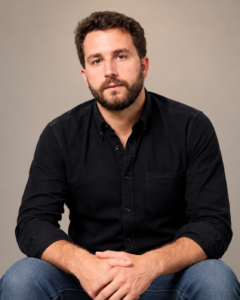
That is where he met Rafael Gijón. They were roommates.
The pandemic caught him as he was finishing university. He earned his degree, but something else happened along the way: his desire to build something of his own intensified. And it was not directed toward the nuclear sector.
The context that created both the problem and the company
The phrase D’Auro uses to summarize Woki’s origin is one that saves several paragraphs: the same context that created the problem created the company.
At the end of 2020, as lockdown restrictions were eased, restaurants began reopening, but with reduced capacity and mandatory advance reservations. Overnight, millions of people who had never booked a restaurant table online had to learn how.
What D’Auro and Gijón realized was that this habit would not disappear when the pandemic ended. It was going to stay. But the restaurant industry did not have the technology to handle this new digital relationship.
Their technical perspective was missing one piece, which came from Pablo Sahakian, a friend of both and a member of the family that owns Manolo, one of Mar del Plata’s historic restaurant brands. Sahakian initially joined as an angel investor and is now the company’s chief financial officer.
The three started with a little more than $100,000 of their own money.
The number they use to open every meeting
Over time, the partners realized that efficiently managing reservations was not the underlying problem.
The real problem was something else, and they describe it with a statistic that works as an opening punch in almost any sales presentation: out of every ten diners who try a restaurant for the first time, only one comes back.
Nine leave and never return.
For a restaurant, that means much of the money spent attracting customers simply disappears. It also means that the customer database it has accumulated —who came, when, what they ordered, what they like— sits there unused.
What Woki built around that observation is what they call an integrated hospitality system. From a single platform, a restaurant can centralize reservations coming from different channels, create profiles for each diner including preferences, allergies and consumption habits, manage waiting lists and seating times, automate email and WhatsApp campaigns, sell experiences, analyze reviews and track occupancy, repeat visits, cancellations and no-shows.
The feature they sell most strongly is first-visit automation: a personalized message inviting someone who has visited only once to return. According to company data, this can increase the return rate to as much as 35%. Sustained over a year, they estimate that it can represent more than $50,000 in additional revenue for a medium-sized restaurant.
And there is one detail of the model D’Auro emphasizes whenever he can: the restaurant monetizes its own customer base without paying reservation commissions.
Against digitizing just for the sake of digitizing
His criticism of the state of the industry is fairly direct and focuses on what was done wrong for years.
He argues that for a long time, digitizing a restaurant was understood to mean replacing a phone call with an online reservation. Nothing more. A change of channel.
For him, real transformation begins somewhere else: when a restaurant can know its customers, understand its own business better and use that information to provide better hospitality.
It is a distinction that sounds subtle, but is not. A reservation system replaces a task. A CRM changes the way the restaurant thinks about the person sitting in front of it.
Michelin, Mar del Plata and three countries
Growth came at a particular moment for Argentine gastronomy. In recent years, the country reached the top position in the ranking of Latin America’s 50 Best Restaurants and welcomed the arrival of the Michelin Guide, two developments that raised expectations across the entire sector.
Woki was well positioned in that environment. Its clients include fine-dining restaurants such as Anchoíta, Trescha, Happening, Gardiner and Mercado de Faena, as well as larger restaurant groups such as La Parolaccia and Fabric Sushi.
Commercial expansion is advancing across Argentina, Chile and Uruguay.
The funding round they decided to stop
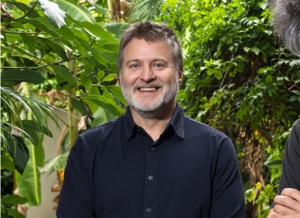
The company closed a funding round led by Gastón Parisier, founder of Bigbox, alongside other figures from the restaurant industry. Parisier also became a permanent adviser.
What happened next is interesting because it goes against the usual logic of the startup world.
The plan included a second investment tranche, considerably larger than the first. D’Auro explained that organic growth results were so strong that they decided to postpone it, and that they would probably raise a larger round later from a stronger position.
In other words: the money was available, and they chose not to take it yet in order to avoid dilution at a low valuation.
The funds they did receive went to two specific areas: hiring product and technology staff, and accelerating commercial expansion in the three countries.
A nuclear engineer discussing allergies and no-shows
It is worth pausing on how unusual the journey is, because it is not common.
Two people trained in one of the most abstract and demanding disciplines in Argentine engineering ended up building software so that a waiter can know that the person at table four has celiac disease and has already visited three times.
D’Auro does not present that as wasted training, but as the opposite. Balseiro training is essentially about learning to model complex systems with many variables. A full restaurant, with rotating seating times, last-minute cancellations, waiting lists and individual preferences, is exactly that.
The company was born without an office, in a city that is not the center of Argentina’s technology ecosystem, using its founders’ own money and at the worst possible moment for the industry they intended to sell to.
Five years later, more than fifteen hundred establishments use it every day.