The sixteen-year-old who shocked Buenos Aires: Renata Schussheim’s long journey
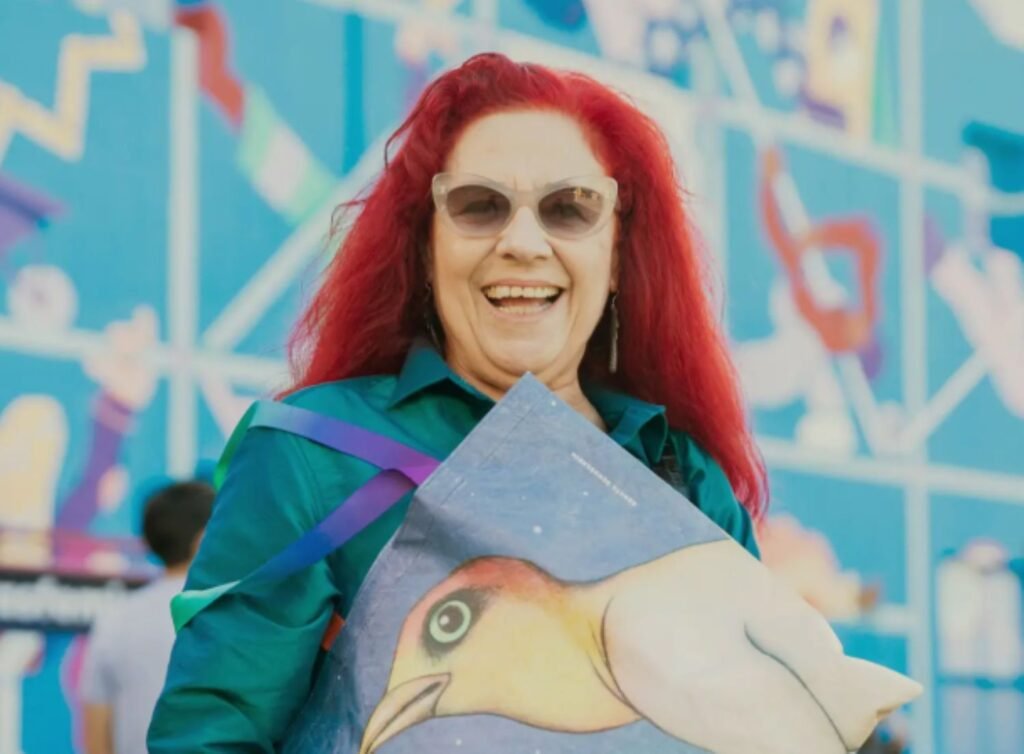
Renata Schussheim desarrolló una carrera de más de seis décadas entre las artes visuales, el teatro, la danza y el rock argentino, con trabajos junto a figuras como Charly García y Oscar Araiz.
There is one scene that sums up the beginning of this story. A sixteen-year-old girl opens her first exhibition in the basement of a Buenos Aires gallery. The works are self-portraits with tiny naked men emerging from their ears. The press is mildly scandalized and labels her an enfant terrible. Then Carlos Alonso, the painter she admired with the devotion of a fan, walks down the stairs into that basement. Decades later, she would say that seeing him come down those steps was her professional validation.
Sixty years later, Renata Schussheim has accumulated more than twenty exhibitions, designed costumes for more than one hundred productions, won two Platinum Konex Awards and secured a place in the visual imagination of Argentine rock. She still draws alone at home, now with a parrot as her studio companion.
A house where actors came and went
Her family environment explains a great deal. Her grandfather was a journalist, and actors from the Jewish theater scene used to stay at her grandmother’s house, including Jacob Ben-Ami. Paloma Efron, the legendary Blackie, would sit at the piano during those gatherings and, according to family stories, attended Schussheim’s first birthday and gave her a little dress.
At around ten, encouraged by her mother, she began studying with Ana Tarsia, a disciple of Juan Batlle Planas. From that period she took away practical skills: how to mix tempera, work with pencil so that the planes were not visible and create gradients. She also learned a method inherited from surrealism: starting with a tangle of free lines and using an eraser and pencil to discover shapes within them. Among those drawings came what would later look like her first theatrical clue: a man and a woman illuminated by something resembling a spotlight.
Her connection with Carlos Alonso came through actor Lautaro Murúa. She was fourteen, studying at the Bolognini Art School and bringing her work to Alonso’s studio on Esmeralda Street. He did not teach classes, but agreed to look over her work from time to time. He was demanding: he immediately spotted any difficulty she had tried to avoid, including an ear hidden because she could not draw it properly. It was Alonso who suggested that she make self-portraits in front of a mirror, an exercise she expected to be easy and found extremely difficult. It eventually produced an entire series —and an exhibition called Autorenatas—.
From the Di Tella to the stage
She was a groupie of the Instituto Di Tella. Ten years younger than Marta Minujín, she wandered into an environment she remembers as magical and where people allowed her to look around freely. There she met Oscar Araiz, who was staging Crash, a work steeped in the pop spirit of the period.
That was also where uncertainty hit her. Jorge Romero Brest was declaring that art was dead and Schussheim, who was only beginning, felt as though she had arrived too late. She asked Roberto Aizenberg what such a statement was supposed to mean. His answer —that as long as someone is moved, art is alive— stayed with her.
Araiz invited her to design the costumes for Romeo and Juliet in 1970, a production later staged in New York with the Joffrey Ballet. She describes the work as an unrestricted personal flight, mixing Russian style, fur and Yellow Submarine, with music by Prokofiev. She also remembers it as a lesson in what not to do: one dancer nearly died wrapped in a fur coat while performing turns with foam rubber on his head.
Her partnership with Araiz has lasted more than fifty years and ranges from A Midsummer Night’s Dream to an adaptation of Manuel Puig’s Boquitas pintadas. In 2026 they premiered another project together, The Rite of Spring, with costumes she deliberately pushed toward something rougher so that the tensions of the present could emerge.
Argentine rock was also design
Her work with music is probably the most widely known part of her career. She designed the presentation for Serú Girán’s album Bicicleta, worked with Charly García during his solo period on Yendo de la cama al living and Piano bar, and created Líneas paralelas – Artificio imposible at the Teatro Colón.
The most remembered episode happened in 1982 at Ferro stadium, during the dictatorship and while the Falklands/Malvinas War was underway. Charly’s idea was that when No bombardeen Buenos Aires began, the scenery —a scale model of the city— would be hit by firebombs launched from the stands. It caught fire. Schussheim and Juan Lepes designed the effect by running wires from the sides of the stadium, without a rehearsal or an international-star budget. She describes it as something made through sheer physical effort.
It never occurred to her to film it. Canal 9 did, and that footage became material for her exhibitions decades later. Documenting everything was never her habit: she made the original and moved on.
The complaint that tried to shut down an exhibition
The most controversial episode of her career looks very different today than it did at the time. Schussheim exhibited at Galería Ática a series inspired by Jean-François Casanovas, actor, transformist and founder of the Caviar group. The works were openly erotic and, following a complaint, there was an attempt to close the exhibition.
She tells the story without much drama and makes a precise observation: many of those images would now be read through categories such as queer, a vocabulary that did not exist in that context at the time. What existed instead was her fascination with Casanovas’s ability to transform himself into someone else, something she says changed the way she thought the first time she saw him perform.
That failed attempt at censorship ended up confirming the direction of her work rather than stopping it. Ambiguity remained her territory: women who were never sweet or accommodating, humanity in animals and animality in people, bears nursing from a young woman’s breast, hats whose feathers turn out to be the eye of a swan.
There is another discomfort she addresses directly: recognition for the craft itself. When a review of Il turco in Italia appeared without mentioning her name, she complained publicly. Someone had worked with the director, chosen the colors and dressed three hundred people. In opera, she argues, critics talk about the voices and the conductor while the rest of the team disappears from the text.
Al rojo vivo: fifty years that are not a retrospective
In September 2023, she opened an exhibition at the Centro Cultural Recoleta spanning five decades of work, curated by Romina Del Prete, who had begun gathering the material during the pandemic. Schussheim rejects the word retrospective. In the exhibition text, María Moreno proposed the idea of open archives: editing, cutting and displacement that create something new rather than arranging everything chronologically.
The three rooms crossed visual and performing arts. There was an army of red costumes, a corridor of costume sketches, prints from Música del Alma in which Charly García was invaded by small Bosch-like figures, three oversized coats bearing the faces of García, Luis Alberto Spinetta and Federico Moura, and a red-carpeted room filled with enormous cushions where visitors watched a documentary assembled from concerts, interviews and music videos, edited by Gianfranco Quattrini with music by her son Daamian Laplace.
A year earlier, during the Bienal de Arte Joven, a 3D-scanned mermaid made in her likeness had been shown at the same museum. A four-year-old girl became obsessed with it and returned every Thursday to see it. When the exhibition ended, her parents told her the mermaid had gone back to the sea. The girl reappeared at the opening of Al rojo vivo, found the flesh-and-blood mermaid and asked Schussheim whether she was wet inside. Schussheim told her yes.
That kind of effect is what she values most. She knows people who began working in art or fashion design after seeing her 2006 exhibition at the Museo Nacional de Bellas Artes, and she connects that back to her own story: she wanted to draw that way after seeing the work of Marie Orensanz, who later became her mentor and whose work she still admires.
Archives, books and two Italian cities
Her current schedule is among the busiest she has had in years. She is organizing her personal archive with a team of archivists and conservators whom she compares to forensic scientists, working among gloves, masks, transparencies and negatives. Materials keep turning up that she did not remember having. The goal is a major exhibition and several books, a process she expects to take a year and a half or two years, requiring a patience she says she does not possess.
She is also preparing two books: one for the Teatro Colón, drawing on an enormous amount of material, and another devoted to costume sketches, appropriately titled Figurines, to be published by Ampersand. The selection even includes designs for productions that were never made, such as a series for Gomina with Casanovas and another for a Don Giovanni with Sergio Renán.
In 2026 she is exhibiting at both ContArt Gallery locations: Venice from August 30 to September 17, and Rome from October 17 to 31. The Rome dates coincide with her birthday. She has her own theory about that city: she says that when you arrive there, you immediately understand why Argentines are the way they are.
What she leaves as a legacy
Schussheim began by exhibiting in a traditional way and eventually mixed everything together: televisions, video, swings for performances, music inside the gallery. She was doing it in the 1980s, when words such as installation, performance and music video were still barely used in the local art scene.
Her method remains deliberately unexplained. The images come from dreams, and she prefers not to intellectualize them. When asked the classic question of what a work means, she answers by asking the viewer another question. She believes some areas of creation should remain mysterious and that, if everything could be explained, she would have become a writer instead of drawing.
What still excites her now comes in two forms: books, because they allow work to circulate in an accessible format, and young artists she discovers on Instagram and messages to tell them she likes what they are doing. Encouragement passes from one generation to another, she says, and for her that is the most valuable thing the profession has.